By my count, Frederick Buechner used the term ‘bare as birth’ at least five times across three of his published works. It’s an odd phrase, yet, the more you stare at it, the more Buechnerian it seems.
To begin with, there is the alliterative use of the “B”, ‘bare as birth’: a pleasing antiphony of plosives, and exactly the kind of opportunity that Buechner, as a stylist, was wont to take. The sounds in ‘bare as birth’ seem calculated to unite with the thing described in order to induce a smirk. And yet, the longer you think about it, and about Buechner more broadly, the more it seems that these words might not just be serving here as a polite or amusing way of informing readers that the person being written about is naked. At the deeper level of rhetoric and semiotics, this phrase gestures beyond the thing described to something profound.
In Buechner’s hands, ordinary things are often made to do this, and thus, we should be unsurprised to see him take a moment of brief exposure — as a character hurriedly changes their clothes or emerges from a river — and turn it into an occasion to consider weightier matters. ‘Bare as birth’. Confronted with another human being, Buechner is not content to let us remain in the present with them but has us stare through the body before us and into the past of the soul that animates it. Whatever ways in which we have come to think about this person over the course of the book, he has us remember that they were born once: vulnerable, innocent, dependent, created.
Of course, in doing this, Buechner is also leading us back into our own pasts. We, too, were born once. Thus, our examination of this phrase tugs at another great theme that runs right through his work. ‘[A]ll our stories’, he writes in Secrets in the Dark (2006), ‘are in the end one story, one vast story about being human, being together, being here.’[1] This observation, naturally, leads to further questions that Buechner is prone to ask:
Does the story point beyond itself? Does it mean something? What is the truth of this interminable, sprawling story we all of us are? Or is it as absurd to ask about the truth of it as it is to ask about the truth of the wind howling through a crack under the door?[2]
‘Bare as birth’. Somehow, this huddle of words manages to summon an awkward smile, and a moment of extrospection, and a moment introspection, and existential questions.
Finally, there is the question of whether Buechner himself actually intended to set this sequence in motion, or whether this is merely an example of an author repeatedly reaching for a pleasing and familiar phrase. Perhaps it’s both, since this author has a habit of lighting upon things that, in rolling through time, have attained to a pleasant smoothness and yet lost much in becoming smooth. This instinct to locate depth, strangeness, and angularity in things that have come to seem shallow, normal, or rounded, led him to write entire books dedicated to re-examining everything from well-worn theological terms to overly familiarised biblical figures. Moreover, as often as he is willing to pour large quantities of ink into this enterprise, he is also inclined to exercise the same instinct in brief moments — moments in which you feel he is turning aside to wink at you, before continuing on his way. He appears to take quiet delight, for example, when writing and when interviewed, in repeating the well-worn, “God knows”, or “God only knows”. Many people avoid this phrase, thinking it blasphemous; many more use it in casual fashion. In one sense, by using it in the same way that they do, Buechner stands with the latter. Yet, in another sense, he is also standing with the former. When Buechner throws up his hands and says, “God knows”, he seems to mean it. So, maybe he is using ‘bare as birth’ in this way, too — as a common phrase, but one that he really means? But, then again, who knows…? This is what it is to read Frederick Buechner.
There is good evidence to suggest the author really meant these words: his use, for example, of a variant phrase, ‘naked as birth’, three times across two books. Additionally, there is also that fact that, bareness aside, birth is a topic to which Buechner’s pen returned often, and in unexpected ways. In 1969, when invited to deliver the William Belden Noble lectures at Harvard, he responded by giving a series of sermons that, taken together, describe a single day. It is worth pausing to observe the literariness of this decision. Buechner critic Dale Brown wrote that when the young author composed his first novel, A Long Day’s Dying (1950), he might well have done so ‘with an outline of the tenets of literary modernism tacked on the wall above the typewriter’.[3] Allowing for the use of this term, Buechner certainly began as a “late-modernist”, and he seems to have carried these instincts with him long after this style of writing had passed out of vogue. The same instincts married in a unique way with his Christianity. Thus, he is able to write in impressionistic fashion of New York City, the very heart of modernity, ‘snarled and seething’ with ‘gorgeous traffic’, as ‘coming down out of heaven adorned like a bride prepared for her husband’;[4] or, returning to the subject at hand, to take a literary convention popularised by James Joyce, Virginia Woolf, and Malcolm Lowry — a novel in a day — and use it as the structure for a sermon series, of all things.
One year after they were preached, the William Belden Noble Lectures were published as The Alphabet of Grace (1970). In part two, ‘Sibilants (7:30-8:30 a.m.)’, Buechner describes an entrance into an ordinary day as a birth-like experience. To wake up, and then wake his daughter, is to experience a flowering into creation:
I am Adam, and it is my birthday, and the world is mine to name, and Katherine, I say, and the whole creation stops breathing or starts breathing as I reach out to touch the sleeping hand. All flesh is grass and like the flower of the field fades, and yet the morning stars sing together and all the sons of God shout for joy as she raises her head and opens one eye the color of wet slate.[5]
What follows is rendered in similarly natal terms, as a genesis in miniature:
Creation is underway. Breakfast is underway. Steam from the tea kettle is fogging up the windows. The cat mews to be let in out of the wet. Getting her bathrobe hooked on the knob of a drawer as she tears by, my wife throws up her hands: "Is it going to be this kind of a day?"[6]
Is it really possible to think of life like this, and to do so every day? Certainly, Buechner not only thinks so but is inviting us to do it with him. This is made clear in the introduction to The Alphabet of Grace, where he writes, in anticipation of the passage we have just read:
Darkness laps at my sleeping face like a tide, and God says, “Let there be Buechner.” Why not? Out of the primeval chaos of sleep he calls me to be a life again. Out of the labyrinth of selves, born and unborn, remembered and forgotten, he calls me to be a self again, a single true and whole self.[…] To wake up is to be given back the world again and of all possible worlds this world, this earth rich with the bodies of the dead as our dreams are rich with their ghosts, this earth that we have seen hanging in space, our toy, our tomb, our precious jewel, our hope and our despair and our heart’s delight. Waking into the new day, we are all of us Adam on the morning of creation, and the world is ours to name.[7]
For Buechner, it seems, life is best thought of as a succession of births. Small wonder that birth should occupy such a significant place within his thought, since he writes from within a tradition within which God Himself experienced a birthing. ‘He was born’, Buechner writes of Jesus in A Room Called Remember (1984), ‘and just let the birth as a birth be wonder enough, which heaven help us it is, this wonder of all wonders’.[8] While serving as chaplain and head of the religion department at Philips Exeter Academy between 1958-1967, Buechner delivered a series of sermons to his students about the birth of Christ, later published in The Magnificent Defeat (1966) and The Hungering Dark (1968). In one of these sermons, ‘The Face in the Sky’, he captures beautifully the harrowing nature of it all, ‘the child born in the night — the mother’s exhausted flesh, the father’s face clenched like a fist’.[9]
The consequences of this birth, above all others, are profound. ‘[F]or millions of people who have lived since’, Buechner proclaims in The Faces of Jesus (1974), ‘the birth of Jesus made possible not just a new way of understanding life but a new way of living it’.[10] Expanding upon this same thought in ‘The Face in the Sky’, he writes:
If holiness and the awful power and majesty of God were present in this least auspicious of all events, this birth of a peasant's child, then there is no place or time so lowly and earthbound but that holiness can be present there too.[11]
So marked is Buechner by this birth, that he is unwilling to leave the concept behind in his description of its cascading effects. The birth of Christ is a birth that leads to further births. Many of them. In a sermon titled, ‘Come and See’, he describes these effects in the following way:
The great promise is that to come to him who was born at Bethlehem is to find coming to birth within ourselves something stronger and braver, gladder and kinder and holier, than ever we knew before or than ever we could have known without him.[12]
Within the Christian understanding of things, the births that this birth might lead to within us are only possible because this peasant’s child died. Buechner is keen to clarify that, if Christ’s life points the way to new birth, then his death makes it possible:
It is the shepherd of light himself who reaches out a hand, who is "Thou" to us. Death and dark are not the end. Life and light are the end. It is what the cross means, of course. The cross means that out of death came, of all things, birth.[13]
Perhaps, with me, you expected that last sentence to end with the word, ‘life’. It is curious that Buechner chose ‘birth’, instead. Yet, theologically, he is pulling on several golden threads here. Twice in the New Testament, in Colossians 1:18 and Revelation 1:5, Christ is lauded as the ‘firstborn from the dead’. Christ’s death leads to another kind of birth for Him, and for everything else, too. In Romans 8:22, we read an account of our present time, that ‘the whole creation has been groaning together in pains of childbirth until now’. Soon, this labour will end in joy, as creation itself is reborn and we along with it. The Bible, then, speaks of many births: the birth of creation, under God’s flickering hands; God’s entrance into creation via birth; Christ’s entrance into new creation through a new kind of birth; our entrance into Christ as a spiritual rebirth; and all creation joining Him beyond the heaving and groaning of the labour we are all experiencing.
It is with all of this in mind that, for Buechner, birth serves as both an organising principle and central mechanism for understanding the Christian life, and our process within it, down to the very fundaments — waking up on an ordinary day. He even turns it into a kind of ethic, writing of our part in this process in The Clown in the Belfry (1992):
Be kind enough to others to listen, beneath all the words they speak, for that usually unspoken hunger for holiness that I believe is part of even the unlikeliest of us because by listening to it and cherishing it maybe we can help bring it to birth both in them and in ourselves.[14]
The birth is ongoing, and yet it is also manifold, for elsewhere Buechner writes that to live in Christ is to experience and engage with a great succession of births: ‘As a man dies many times before he’s dead’, says the sage of Rupert Mountain via Saint Godric of Finchdale, ‘so does he wend from birth to birth until, by grace, he comes alive at last’.[15]
Perhaps you are wondering why I have chosen to devote the final issue of this edition to this topic. So far, the word “birth” has appeared forty-two times in this article. Now it’s forty-three. Even the most patient reader must be tired of reading it.
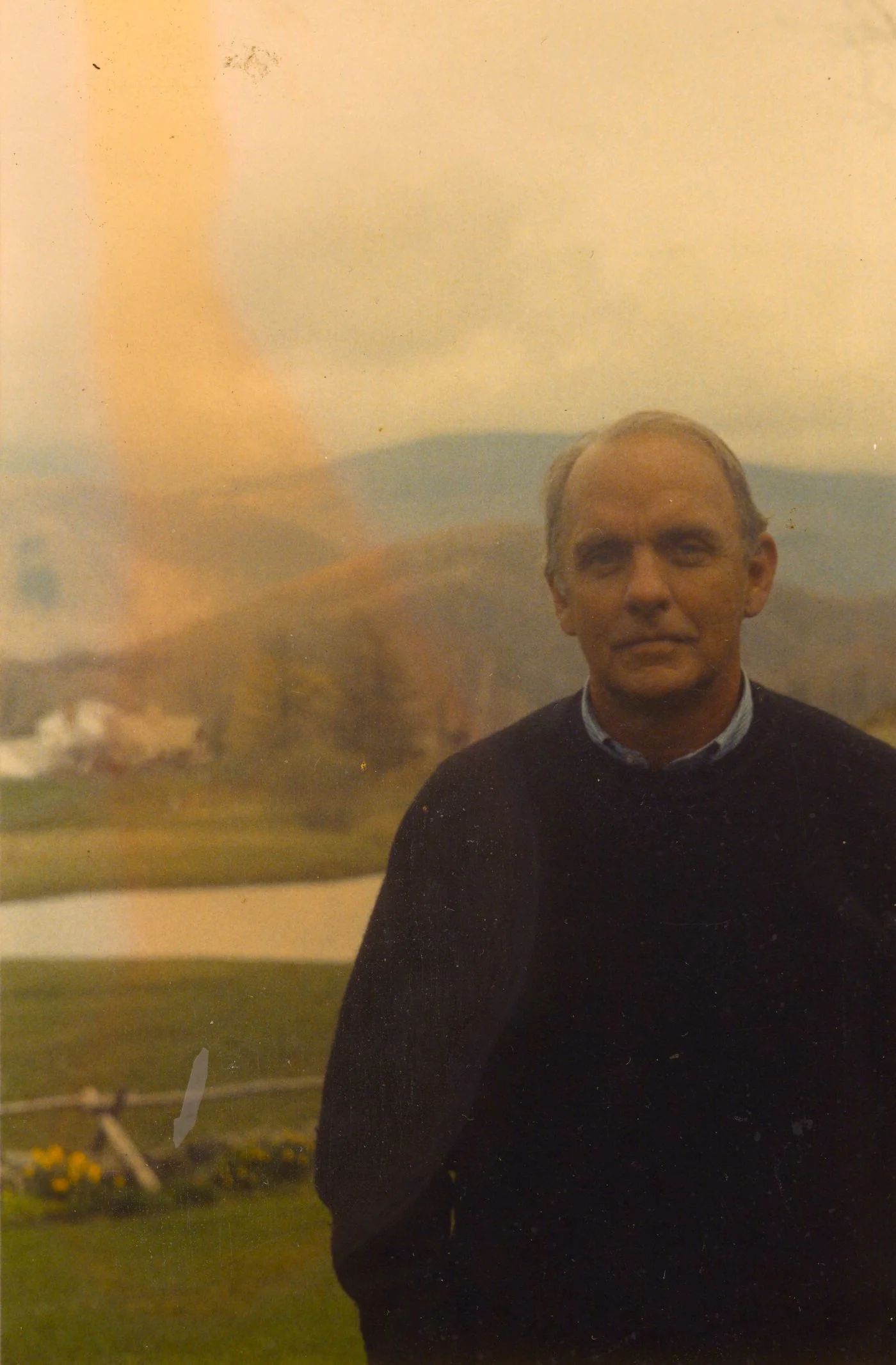
The answer, of course, is that Frederick Buechner was also born once — almost 100 years ago, in fact, on Sunday, July 11, 1926.
The coming edition of Buechner Review (‘26 – ‘27), due to commence next month, is dedicated to a year-long celebration of the centenary of our namesake. Continuing the work of this and previous editions, the centenary edition will look forward to the next 100 years: to Buechner studies, a sapling full of promise within the forest of literary studies; and to supporting work that follows in his footsteps, both in the spirit of his writing, and in the forms of writing he mastered.
As editor, I wish to take this moment to congratulate each writer whose work featured in the ‘25 – ‘26 edition, to thank our faithful subscribers for reading it, and to issue each of you with an invitation. Please do join us in the coming year — and why not bring your family, friends, colleagues, and students with you? — as we celebrate the many births of Frederick Buechner.
EDITOR’S NOTE: Thank you for reading The Buechner Review. If you would like to receive future articles in your email inbox you can sign up here.
Works cited:
[1] Frederick Buechner, ‘The Truth of Stories’, Secrets in the Dark: a life in sermons (New York: HarperSanFranciso, 2006), p.137.
[2] Ibid., p.137.
[3] Dale Brown, The Book of Buechner: a journey through his writings (Louisville, KY: Westminster John Knox Press, 2006), p.19.
[4] Frederick Buechner, ‘The Kingdom of God’, The Clown in the Belfry: writings on faith and fiction (New York: HarperSanFrancisco, 1992), p.167.
[5] Frederick Buechner, The Alphabet of Grace (New York: Phoenix Press, 1970), p.64-5.
[6] Ibid., p.64-5.
[7] Ibid., p.25-6.
[8] Frederick Buechner, ‘The Two Stories’, A Room Called Remember (New York: Harper and Row, 1984), p.51.
[9] Frederick Buechner, ‘The Face in the Sky’, The Hungering Dark (New York: Seabury Press, 1968), p.14.
[10] Frederick Buechner, The Faces of Jesus: a life story (New York: Simon and Schuster, 1974), p.42.
[11] Buechner, ‘The Face in the Sky’, The Hungering Dark, p.13.
[12] Frederick Buechner, ‘Come and See’, The Hungering Dark, p.55.
[13] Frederick Buechner, ‘The Clown in the Belfry’, The Clown in the Belfry, p.114.
[14] Frederick Buechner, ‘Growing Up’, The Clown in the Belfry, p.147.
[15] Frederick Buechner, Godric (New York: Atheneum, 1980), p.99.
Sign up here to receive articles in your inbox
