Even if we lay aside the great cathedrals and the advancements in every art form that they entail, and the canon of western music, the most accomplished of our painters, and even if we set aside for the moment the great civic achievements — the invention of hospitals, orphanages, and such, and science, let’s leave science to one side too — there are still other areas of human creation, either invented whole cloth or practiced all but entirely by Christians, without whom they would cease to exist in any meaningful way.
There are in fact too many of these to go on about, even within the genre of literature, wherein I mean to situate us. Consider: would apocalypse as a genre, exist without people for whom the end times are a concern? Or devotionals — would there be books with dates in them to tell readers when they should be read without the quiet time crowd? Would allegory be necessary as a category, and thus as a mode of creation, if there weren’t people who shared an over-story to which allegories might refer? I doubt it very much.
Here though, I want suggest a mode of literary creation which I think understudied as such, and which all but certainly would not exist without Christians practicing it. It’s important not only for that fact, which after all may be nothing more than a novelty, but for its vast reach, influence, and sheer number of practitioners, of whom, I count Frederick Buechner among the best.
I mean the sermon, of course, a writerly creation often but not always in the expository mode, with distinct features and generic expectations, that is, I would contend, the most widely created and experienced literary genre practiced in the English-speaking world (and in many others besides).
Is that overstating things? At last census, there were around 400,000 individual churches in America alone. Think of it: every Sunday, every year, decade after decade, in at least 95% of those, someone is sitting down and drafting sentences which they will read aloud as a kind of performance in front of a (mostly) rapt audience. Are short stories written more often that? Poems? Is any mode of literary creation more commonly written, or, more tellingly, more commonly received? How many families will not read a single book in a year, but will go to listen to sermons week in and week out?
What’s more, in most cases, it’s the same audience the writer had the week previous. What a strange bit of work this is! How unique its demands! Stand-up comics, by way of comparison, also script a verbal performance based on sentences, but they get to reuse material week after week, refining the hits, beats, and pauses. Even the most popular of them don’t perform every week. But preachers will often preach to the same crowd for years. Their parishioners know all their stories, all their jokes, and often know them personally and their families as well. Every bit of this is unique in the literary world. I give poetry readings and talks all over, but like the comics, have the good fortune to face a fresh crowd for each one.
Sermons are also a unique bit of literary craft in that they are beholden, often twice. Though exceptions naturally exist, some of them culturally, or temperamentally, fortified, the expectation on the part of sermon-hearers, the “audience,” it that the piece will refer to, spring from, and perhaps illuminate some bit of scripture and that it will provide a practical “take-away:” something they know now, having heard the sermon that they didn’t know before, or something they can now do, which they otherwise might not have done. That’s a lot to ask of a piece of writing that takes somewhere between 20 mins and an hour to deliver.
Some of these differences are, of course, denominationally aligned. Non-denominational or Baptist churches might center the take-away, the application, while Mainline denominations, of which Buechner was a member, might focus more on the scriptural expostulation.
But before looking more closely at how Buechner used — I’d say perfected — the sermon as a mode of literature, I want to stress again the strangeness of these creations, specifically within the liturgical setting, because modes of Christian worship vary, and rather widely. What occurs, in churches like Buechner’s on a Sunday, is, after an opening acclimation and a hymn or two, the public reading of scripture, aloud: traditionally a passage from the Old Testament, a Psalm, a New Testament passage, and a selection from the Gospels.
For those in other traditions, that may seem like rather a lot of Bible-reading, as indeed it is. Crucially though, the minister does not select the texts read, but follows a calendar of readings from each, that, due to their varying lengths, always pair differently from year to year. The minister may elect to speak on one of the passages, ignoring the others — or, rather, letting them rest and do their work in the hearts of his hearers without comment from the pulpit — or he may braid them together in some novel form, listening for the connections between them.
Two important ramifications spring from this structure. First, the preacher in such a setting is rarely permitted to preach topically, identifying a relevant theme or area of concern and combing through the scriptures for texts to illustrate his position thereon. No, he is bound by the calendar of readings. Second, the audience has just heard the same material on which the sermon is to be delivered. This phenomenon makes the minister more like a professor whose students have just (presumably) read the assigned Shakespeare, for instance, and had time to come to their own conclusions before — in the best cases — the professor’s interpretation of the passage blows the text wide open, the students shaking their heads in disbelief muttering why didn’t I notice that?
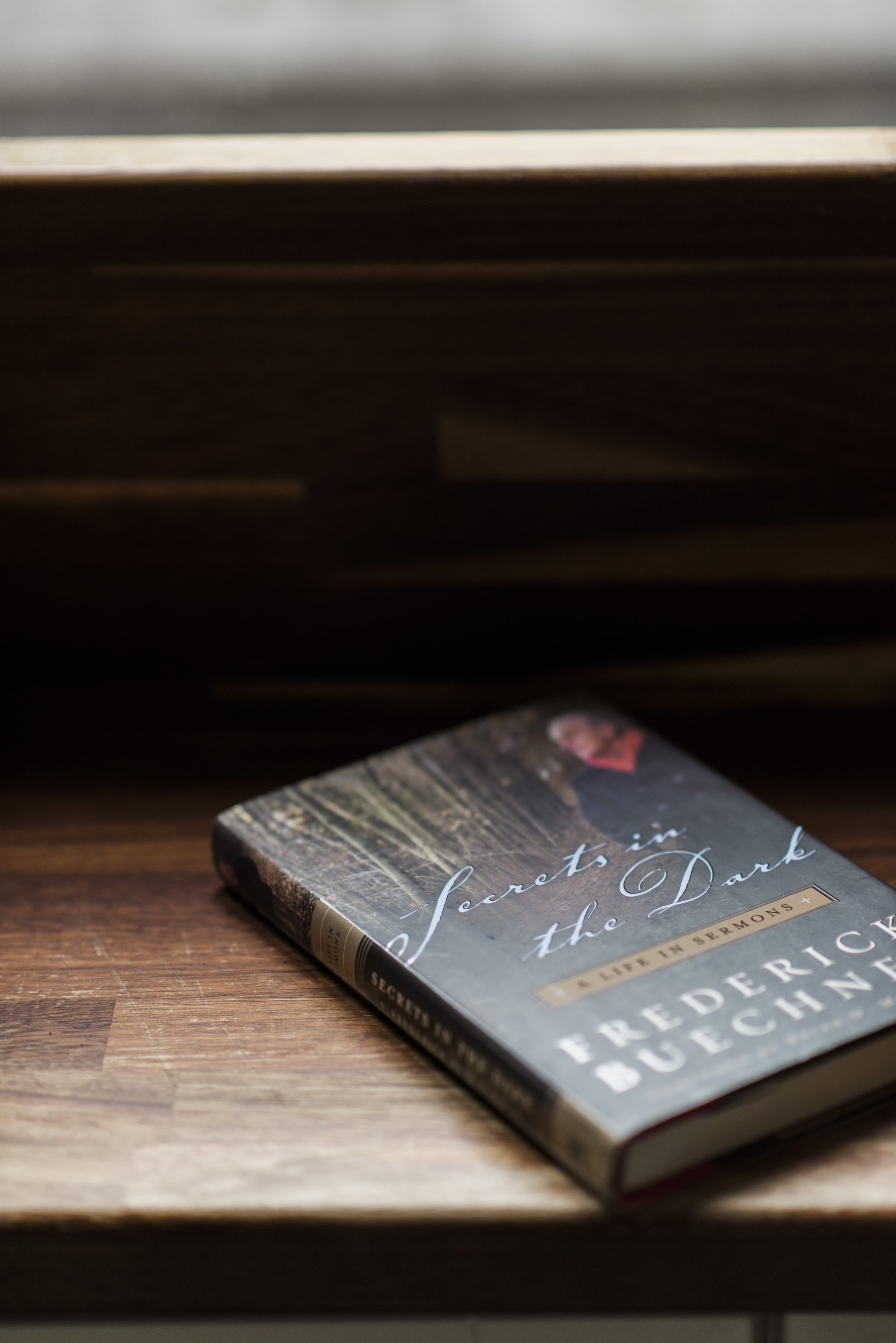
Buechner preached a good number of sermons throughout his sixty-four years as a minister, and happy are those that heard him do it, but the rest of us are blessed to have the collection Secrets in the Dark: a life in sermons (2006), both for our own literary and spiritual edification, and as a testament, a mere taste of what went on in his parish. Actually, I chanced to hear him preach one year at Wheaton College. I’d never heard his speaking voice before and was stunned to hear even his casual, or social, remarks dealt out in the same elegant syntactic registry as his published writing. So, what is Buechner like as a sermonizer?
Well, it probably sounds a little absurd to say it, but in the first place: literary. By this I mean that the sermons read so naturally on the page it’s hard to imagine someone actually speaking them. Long Proustian sentences deal themselves out and double back, a bit like G.K. Chesterton’s, come to think of it, which might be seem artificial in a human mouth, perhaps overly-determined. They are replete with references to books and decorated with untranslated French phrases here and there. They’re full of deliciously compressed language of a type no one really speaks, that approaches poetry: ‘spindle-shanked crackpot, Mary’s boy, God’s son, flattened out on the face of a cliff, like a spider’. [1]
But they’re also narrative, cinematic. Stylistically, Buechner will sometimes force the reader/parishioner into relevance through perspective. ‘The telephone rings late one night and you jump out of your skin,’[2] one illustration begins. I don’t know about you, but I have never, in a lifetime of church-going, heard a sermon that either had that level of drama at the point of delivery, nor that used second-person address in a narrative, rather than, say, an applicative mode. He continues the suspense: ‘You try for awhile to pretend that it is not ringing, but after a while, you answer it because otherwise you will never know who it is.’[3] Effective. Tense. Unusual. I’ve been blessed to sit in congregations of very talented preachers; why have I never heard anything like this before?
Sometimes though, the sermons are, at least structurally, quite usual. One sermon called “The Face in the Sky” begins, ‘As the Italian Film La Dolce Vita opens, a helicopter is flying slowly through the sky not very high above the ground,’ and it goes on for some while to describe the opening shots of the film.[4] Granted, this is Fellini’s masterpiece of Italian neorealism being referenced, but it’s not a far cry from “Have you guys seen the new Transformers?” I mean to say that they do the normal sermon things, if in a rather elevated fashion.
Others of them are dramatic in a different way: not that they narrate a dramatic scene or exchange into which listeners are invited, but that they become one. Taking the interrogative mode at the beginning of, for instance “Message in the Stars”, Buechner addresses the audience directly. He begins with, ‘If God really exists, why in heaven’s name does God not prove that he exists instead of leaving us here in our terrible uncertainty?’[5] This is the kind of challenge a more traditional rhetorician might save for the sermon’s end, after expostulation, etc., when the minster feels the audience is really with him and can face hard questions. Buechner begins with it. ‘Why does he not show his face so that at last a despairing world can have hope?’[6] Indeed. And this, this fiery polemic is offered after Philippians 4:6-7 has just been read, featuring the commandment to ‘have no anxiety about anything.’ The juxtaposition is jarring even from here, with the good reverend no longer with us, except in these pages. How much more must it have been to hear it thundered, or even moused, from the pulpit?
Buechner not only performed the preacher’s role, but thought about the calling itself across several books, so we have his thoughts on what he was doing, or meant to do. “The clown in the belfry” was his image of the minister’s art (and the title of an earlier collection of sermons and essays). He took it to be something slightly absurd, something fool-ish in the Shakespearean sense. Because he took the gospel itself to be improbable to the point of comedy, he imagined its ministers must be similarly so.
He’s hugely articulate on the calling of being a teacher and of being a writer elsewhere, but when he discusses the task of being a preacher, one senses he thought the work it was mostly to be a believer, to have faith on behalf of those who cannot quite manage to, to offer comfort and spiritual direction — even if that direction is back and the comfort cold. If he agonized over his sermons, or if they came to him whole cloth, inspired, I don’t know. What I do know is that they are a model of faith amidst doubt, of beauty against indifference to it, and of the same literary and cultural range and writerly surprise that leant every task he approached a little wink, a hint of magic.
EDITOR’S NOTE: Thank you for reading The Buechner Review. If you would like to receive future articles in your email inbox you can sign up here.
Works cited:
[1] Frederick Buechner, ‘The Sign by the Highway’, Secrets in the Dark: a life in sermons (New York: HarperCollins, 2006), p.33.
[2] Buechner, ‘The Calling of Voices’, Secrets in the Dark, p.36.
[3] Ibid., p.36.
[4] Buechner, ‘The Face in the Sky’, Secrets in the Dark, p.22.
[5] Buechner, ‘Message in the Stars’, Secrets in the Dark, p.16.
[6] Ibid., p.16.
Sign up here to receive articles in your inbox
