EDITOR’S NOTE: The Buechner Review is proud to collaborate with a growing number of higher education institutions and seminaries around the world in hosting writing competitions. Named in honour of Frederick Buechner, these competitions encourage student entries of written pieces inspired by his work. This edition of the Review features three pieces, selected from last year’s competition winners by our editorial board. We are pleased to present the third of these to you here: the winning entry of the 2025 Frederick Buechner Writing Competition at Western Theological Seminary.*
It was with embarrassment that my nineteen-year-old self quietly ripped a piece of paper from my notebook. In a spur of bravery, I found my father in the next room and slipped the shred into his hand. Before he could read it, I flitted away into my room and closed the door. I held my breath as he read my small handwriting (writing small is the whisper of cursive): “Signs and symbols don’t speak like sentences.”
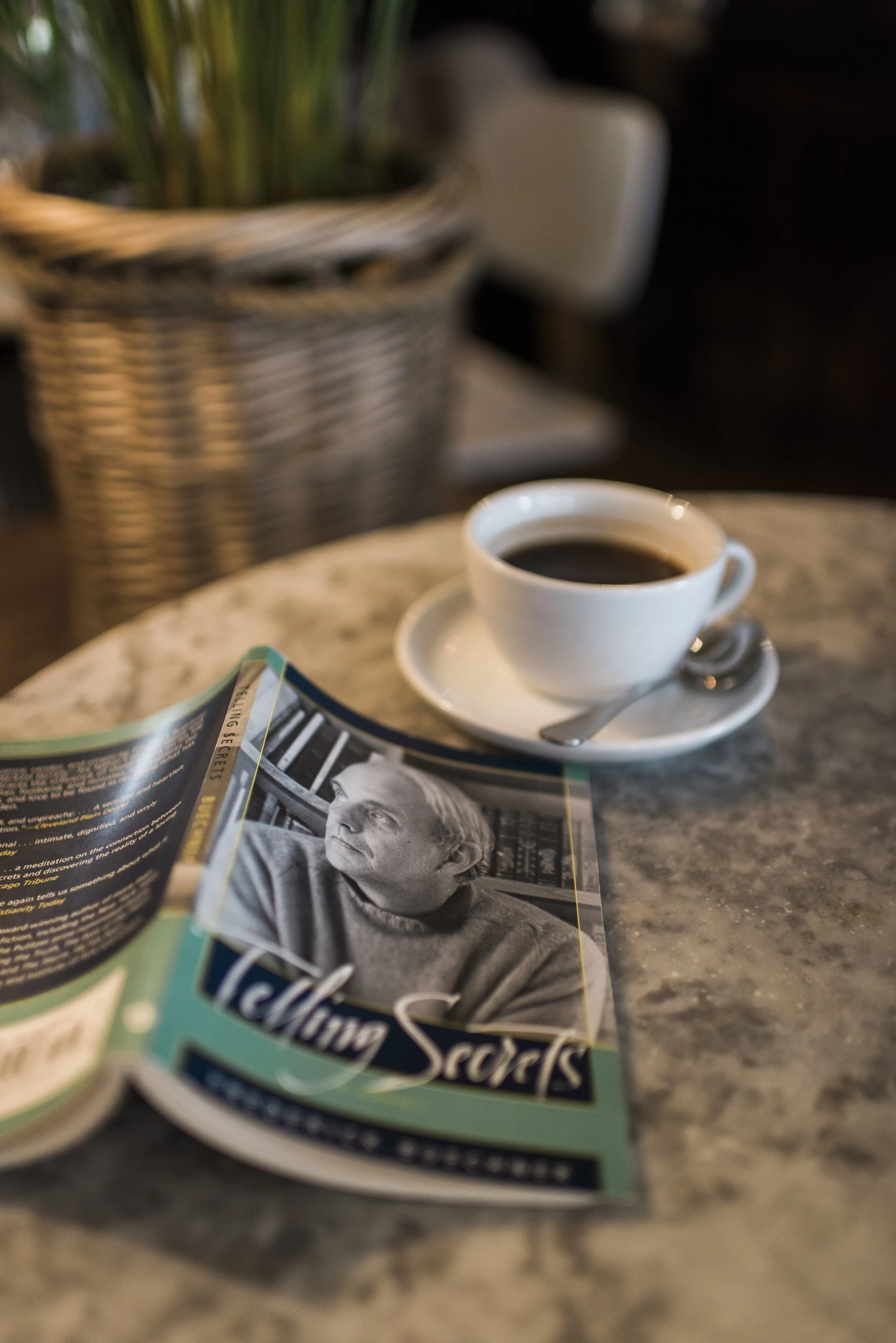
It was a few years earlier, in high school, when I first read Buechner. I remember “The Dwarves in the Stable”, the first chapter of his third memoir, Telling Secrets (1991), because I butchered an essay about it. I compared myself to Buechner’s mother in that,
hers was a heart that, who knows why, was rarely if ever touched in its deepest place. To let it be touched there was a risk that for reasons known only to her she was apparently not prepared to take.[1]
I didn’t have words to articulate why this resonated so deeply with me. Regardless of what immediately resulted from this essay, which was academic failure, themes from Buechner’s writing lived in the back of my mind like seeds growing roots. In particular, there were two things that stood out to me. First, that it is possible to be a living testimony of beauty from ashes. Second, Buechner had an anorexic daughter.
My father also had an anorexic daughter. The years after high school found me in and out of hospitals and clinics. I was more afraid of eating dinner than dying. My choices were hardly logical to me, but logic was less motivating than the desirable aches in my empty stomach. My father loves me deeply. He often holds his emotions securely behind stoicism, but my eating disorder broke the levee of his tears, as he watched me struggle in the tension between death and life. A cloud of grief hung in our home as I withered away.
Pain seems to be a universal experience. Perhaps you’ve heard it said that pain can make a person better or bitter. Everyone deals with suffering differently. No matter how much pain and loss a person experiences, there is hope.
I wonder if, like me, Beuchner’s daughter might have found that last sentence rather irritating. Despair rejects hope, and despair was a well-worn path that I took on tiptoe. I say tiptoe because I released my feelings only through quiet metaphors, not sentences. My body became my most valuable method of communication. Behind the disguise of health and self-control, I deprived myself of enough nutrition. I also cut my skin, hoping that emotional wounds might heal if I carve them into my body. Over time, I lost my sense of self to these behaviors. I didn’t recognize myself. My symbol, my emaciated face, became unrecognizable to my own brothers as they passed me on the sidewalk.
In wisdom, Buechner suggests that people speak lovingly to themselves, to one another, and to God. Love does not confuse and manipulate, love is honest. Love is brave. So, I built a bridge between my father and me. We both desperately wanted comfort, understanding, and a healthy relationship. I shared “The Dwarves in the Stable” with him and scribbled my note to tell him that I wanted to start communicating in a way that could be understood. I want to be known and loved. I wanted to know and love.
The fearsome blessing of that hard time continues to work itself out in my life in the same way we’re told the universe is still hurtling through outer space under the impact of the great cosmic explosion that brought it into being in the first place. I think grace sometimes explodes into our lives like that - sending our pain, terror, astonishment hurtling through innerspace until by grace they become Orion, Cassiopeia, Polaris to give us our bearings, to bring us into something like full being at last.[2]
In the gravity of grace, Christ was pulls us towards himself.
As my father and I continued this journey of health and healing, Buechner and his daughter stayed with us. They were kindred spirits, in a way.
Complicated as paternal relationships often are, they can become beautiful microcosms of the way our Heavenly Father loves his children. Around the same time that my dad and I experienced our communication crucible, I became more honest with God as well. I’ve said I deserve death, God agrees that the wages of sin are death, so he died on my behalf. I’ve said I don’t belong anywhere, God says I’m made in his image and I’m his family now. I’ve said I have no future if I can’t control it, but God says he has good plans for me.
How easy it is to write such words and how impossible it was to live them.
I stared in the mirror, disgust flooding my view of the woman staring back at me. She had dark circles under her eyes and an acne-scarred, tear-stained face. I’d stick out my tongue at her and hope that disdain would somehow make her better. Surely a God who sees everything must condemn her, too?
Shockingly, God’s word is clear that I am loved. God’s word is good. I don’t know what my IQ is, but God’s is higher. To inform God how he should scold me and whip me into shape is placing myself above the God who simply loves me. He asks if I’m willing to rest in the comfort of his love.
‘The other way to say it’, writes Buechner of the great commandment, ‘is, Love yourself as your neighbor’.[3] I don’t feel lovable or acceptable, but I choose to act and believe that I’m forgiven through Jesus.
Who cares? What in the world could be less important than who I am and who my father and mother were, the mistakes I have made together with the occasional discoveries, the bad times and good times, the moments of grace […]. But I talk about my life anyway because if, on the one hand, hardly anything could be less important, on the other hand, hardly anything could be more important. My story is important not because it is mine, God knows, but because if I tell it anything like right, the chances are you will recognize that in many ways it is also yours.[4]
Do you mind if I indulge in being cliché by concluding my writing by stating boldly that which has thus far been implied? After all, I am living by a new standard of articulate communication, so please allow me to tell you what I hope you take away.
Love is resilient and brave. God is love, and you are called to love. Loving well is only accomplished through the cross.
“Abide in me, and I in you. As the branch cannot bear fruit by itself, unless it abides in the
vine, neither can you, unless you abide in me.” (John 15:4)
EDITOR’S NOTE: Thank you for reading The Buechner Review. If you would like to receive future articles in your email inbox you can sign up here.
*If you would be interested in your higher education institution hosting a Frederick Buechner Writing Competition, you can reach out to us here.
Works cited:
[1] Frederick Buechner, Telling Secrets (New York: HarperCollins, 1991), p.15-6.
[2] Ibid., p.24-5.
[3] Ibid., p.27.
[4] Ibid., p.29-30.
Sign up here to receive articles in your inbox
