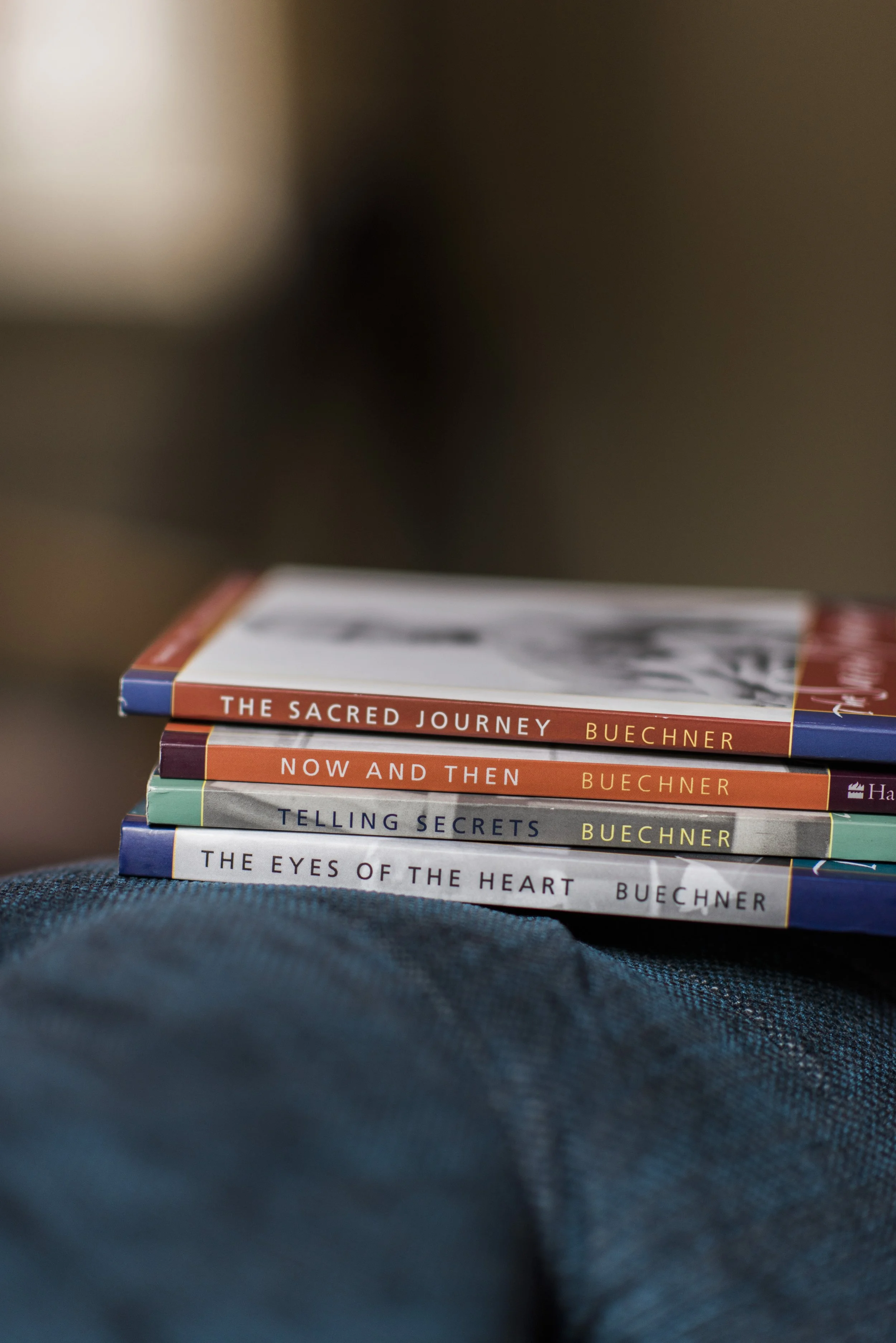
EDITOR’S NOTE: The Buechner Review is proud to collaborate with a growing number of higher education institutions and seminaries around the world in hosting writing competitions. Named in honour of Frederick Buechner, these competitions encourage student entries of written pieces inspired by his work. This edition of the Review features three pieces, selected from last year’s competition winners by our editorial board. We are proud to present the second of these to you here: the winning entry of the 2025 Frederick Buechner Writing Competition at Buechner’s second alma mater, Union Theological Seminary, New York.*
◼
The news came in the middle of a conversation about flight prices.
It was a Tuesday evening, and I was on the phone with my cousin, Kwaku Manu, scrolling through flights back to Accra. The funeral was set for next week. Too soon, too sudden. I hadn’t even had time to sit with the fact that my mother was gone. The call had come at 3:12 a.m.—the kind of call that empties the breath from your body before you even press accept.
Now, I was trying to calculate if I had enough money in my account to afford sorrow.
“This one is about $1,800,” Kwaku Manu was saying. “It lands in the afternoon. Maybe Ama Serwaa can pick you up.”
I wasn’t listening. My mind was still caught on that last hug. The airport terminal, my mother’s arms wrapped around me, the smell of cloves and cocoa butter in her scarf. How I had let go too quickly, embarrassed, even though no one was watching.
I had thought I’d see her again.
“Nana Kofi, remember who you are,” she said between sobs, clutching my hands as if, by sheer will, she could hold me in Ghana.
Her fingers trembled in mine, a tightness that had once meant safety, but now felt like the weight of departure.
I nodded, but what did that mean? Who was I? A boy from a country where suffering was worn like a second skin, where love was as much sacrifice as it was affection, where grief was a lifelong companion. My father left when I was twelve. My mother, despite her softness, never spoke of him. In Ghana, you buried grief with the dead and only let it haunt you in private.
I told myself I would not cry, but when I turned back for one last look, I saw her—small and shrinking in the airport crowd, shoulders hunched in resignation. A lump rose in my throat.
“Are you listening, Nana Kofi?” Kwaku’s voice pulled me back.
“Yeah,” I said, though I wasn’t sure if that was true.
There is a peculiar thing about grief that no one tells you—it does not feel real at first. It moves through the body like a foreign language, a sensation both familiar and impossible to name. I had been in America for three years, carrying a version of home in my accent, in my habits, in the way I could not bring myself to throw away old rice even when I had no intention of eating it.
But now, home had lost its center.
◼
The first time I heard my mother cry, I was twelve.
It was after my father left. I woke up to the sound of it—a deep, guttural thing, as if her ribs had broken inward. I had never known my mother to cry. She was a woman who believed suffering was best endured in silence, a belief passed down like an heirloom from her own mother and her mother before that. In our house, sorrow was swallowed whole.
I never told her I heard. I just crept back into bed and decided, then and there, that I would be the man of the house.
And I had tried.
I tried when she came home late from selling fabric in the market, when I saw the exhaustion settle into her shoulders like a permanent weight. I tried when she counted coins for rent, stretching cedis like they were elastic. I tried when she sent me off to America with a smile so bright it could have been mistaken for joy.
“You will do great things,” she had said, placing a hand on my cheek. “Make me proud.”
And I had nodded, swallowing the part of me that wanted to say, But what if I want to stay?
What if I didn’t want to be great?
◼
America was cold. The kind of cold that made you ache in places you didn’t know existed. I moved in with my uncle, a pastor who had been in New York long enough to forget the way Fante words should fall off the tongue. He was broad and loud, a man who loved to tell stories about suffering as if they were his greatest achievements.
“When I first came here,” he told me, his voice swelling with pride, “I worked three jobs. You know why? Because suffering builds character. Suffering is holy.”
He said holy the way some people say water. As if it were necessary for survival.
His wife, Aunty Martha, was softer. She made me jollof when I complained about American food and rubbed shea butter on my cracked lips, shaking her head at how quickly harmattan could make its way across the ocean and settle in my skin.
“Don’t listen to your uncle too much,” she whispered one evening. “Not all suffering is holy. Some of it is just suffering.”
I thought of my mother, of her hands, of the way she never allowed herself to grieve. Was her suffering holy? Or was it just suffering?
◼
On the flight home, I thought about my mother’s hands.
How they had known the weight of carrying. Carrying children, carrying grief, carrying a faith that had never been gentle with her. She believed in a God who required endurance, who tested the strongest, who turned suffering into salvation.
Maybe that was why she never asked for much.
Maybe that was why she never told me she was sick.
The thought made my throat tight, and I turned my face toward the window. The sky outside was a dark, endless stretch, the clouds below looking almost solid. I imagined myself stepping out, walking across them like some kind of miracle.
The man sitting beside me was reading a Bible. I recognized the passage—Matthew 5, the Beatitudes.
Blessed are those who mourn, for they shall be comforted.
I let out a breath that almost sounded like laughter.
I did not want to talk to God. I wanted to ask Him why He had taken my mother. Why He had made suffering a language my people spoke fluently. Why He had let me believe there was time when there was none.
This brought memories of my last church service at my uncle’s church in America before hopping on a flight to Ghana. The preacher was a young man with kind eyes. He spoke of grief as if it were something alive, something that curled itself around your ribs and made a home in your chest.
“Listen to your life,” he said, voice steady. “It is always speaking to you. Even in pain, even in loss. Pay attention.”
Pay attention.
I wanted to scream that I had been paying attention my whole life. That I had watched my mother work herself to the bone, had seen my father’s name become nothing but a whisper, had carried the weight of expectations that no one asked if I wanted.
But I said nothing.
◼
Accra smelled the same. Hot earth, the metallic tang of rain in the air.
But there was something different in the way it felt. It was strange, coming home to a version of it where my mother no longer existed.
Ama Serwaa was waiting for me outside the airport.
She looked like she had been crying for days.
“Nana Kofi,” she said, pulling me into a hug that smelled of peppermint and talcum powder. She held on for a long time. Maybe she had learned something I hadn’t.
“You’ve lost weight,” she murmured.
I wanted to say something light, something easy, but all I could manage was, “Yeah.”
We rode in silence. The roads home were as I remembered them—potholed and unpredictable, where a single wrong turn could send you into a parallel universe of dust and regret. The radio played an old Osibisa song, and the past swam up to meet me. The streets were familiar—vendors with makeshift stalls, women balancing baskets of fruit on their heads, and the occasional goat wandering too close to the road. I had missed this chaos, this particular rhythm of life.
◼
At home, the house was full of people. Mourners. Neighbors. Distant relatives who had suddenly remembered we were family. Someone pressed a bottle of Malta into my hands. I took it without thinking.
The grief here was loud. Wailing, singing, the clatter of pots in the kitchen. It was different from the kind I had been carrying alone in New York, the quiet, polite kind that sits in the chest like an unanswered question.
I found a corner in the hallway, sinking onto the floor.
And then, the memories came.
My mother at the stove, humming an old hymn. My mother, scolding me for forgetting to sweep the yard. My mother, slipping a few extra cedis into my pocket when she thought I wasn’t looking.
I pressed the heels of my hands into my eyes, as if I could push the grief back in. As if I could make it behave.
But then, I heard a voice.
“She would have wanted you to eat something first.”
I looked up. It was Uncle Kojo, my mother’s younger brother.
I hadn’t seen him in years, but he looked the same. Always slightly amused, as if life itself was a joke he was in on.
“You know,” he said, lowering himself onto the floor beside me. “Your mother was stubborn. Strong, yes, but stubborn.”
I gave a small, hollow laugh. “Yeah.”
“She never wanted to be a burden,” he continued. “That’s why she didn’t tell you.”
I swallowed hard. “I could have come home sooner.”
“She wouldn’t have let you.”
We sat in silence for a while. Outside, the wailing had turned into singing. Someone was leading a chorus, voices rising and falling in something that wasn’t quite harmony but felt like it.
“Do you remember when you were little?” Kojo said suddenly. “You used to follow her everywhere. Even to the market. She used to say, ‘This boy—he thinks I carry the sun in my pocket.’”
I let out a breath.
“She did,” I said.
Kojo nodded, his eyes glistening.
I thought about the last time I saw her. The way I had let go too soon.
The way she had held on, just a second longer.
I closed my eyes.
I listened.
And for the first time since that call at 3:12 a.m., I let myself feel it.
The weight of her. The absence of her. The love she had left behind.
And somewhere in the grief, I searched for meaning.
Somewhere in the grief, I searched for myself.
◼
The first night back home, I didn’t sleep.
I lay on my old mattress, listening to the house breathe. The wooden beams shifting, the distant hum of a generator, the occasional cough from an uncle sleeping in the next room.
Everything in this house had carried my mother’s presence, and now everything carried her absence.
Her bedroom door stayed shut.
That was the thing about grief in Ghana—it lived in the walls, in the air, in the silence between the wailing. People came to mourn loudly, to remind us that she was gone. But the real grief happened in the quiet, when the last mourner left, when the last bowl of jollof had been served, when the last hymn had been sung.
I turned onto my side, staring at the ceiling. Somewhere deep in my chest, there was an anger I hadn’t named yet.
She hadn’t told me. She had suffered in silence, just like she always had.
And I had been in New York, living a life she sent me to have.
The next morning, I stepped into the kitchen and found Ama Serwaa kneeling over a steaming pot of light soup. She was dressed in all black, her wrapper tied tight around her waist.
“You couldn’t sleep,” she said without looking up.
I sighed, rubbing my face. “No.”
“Grief does that.”
She stirred the soup, the ladle moving in slow, deliberate circles. For a moment, it looked like she wanted to say something else. She was quiet at first, then she whispered, I miss her, Kofi.
I closed my eyes.
“Me too.”
A pause. Then, “Do you think she knew?”
Knew what? That we loved her? That we were sorry for every missed call, every moment we had chosen distance over presence?
Then she turned off the fire and sat back on her heels.
“You need to go see Auntie Portia.”
I frowned. “Who?”
She gave me a sharp look. “Mama’s best friend.”
I vaguely remembered her—a tall, stern woman who lived in the next neighborhood.
“She wants to talk to you.”
“About what?”
Ama stood, wiping her hands on a towel. “Go and hear for yourself.”
Auntie Portia’s house smelled of camphor and old wood.
She was waiting for me on the porch, sitting in a low chair with a Bible in her lap.
“Nana Kofi,” she said, her voice slow, deliberate.
“Auntie.”
She gestured for me to sit. I did.
For a long moment, she didn’t say anything. Just looked at me, as if deciding where to begin.
“She was a good woman,” she said finally. “Your mother.”
I nodded, swallowing the lump in my throat.
“She carried a lot.”
Another nod.
She exhaled, tapping her fingers against the Bible. “Did she ever tell you about your grandfather?”
I frowned. “What?”
She studied me carefully. “I see. So she never did.”
I shook my head. I had never heard my mother speak of her father. Not once.
“He was a pastor,” Auntie Portia continued. “A hard man. He believed suffering was a test of faith. He told your mother, from the time she was small, that God gives his toughest battles to his strongest soldiers.”
She paused. “She believed him.”
Something heavy settled in my chest.
“She spent her whole life enduring,” she said. “Even when she didn’t have to.”
I looked away, my jaw tightening.
“She didn’t tell you she was sick because she didn’t want to be a burden,” Auntie Portia said softly. “She didn’t want to take anything from you. She only knew how to give.”
The anger inside me sharpened.
I clenched my fists. “But she was my mother.”
“Yes.”
“She could have—” My voice broke. I swallowed, pressing my palms against my knees. “She could have told me.”
Auntie Portia sighed. “She loved you, Nana Kofi.”
I squeezed my eyes shut.
“She didn’t want you to carry the weight she carried.”
I laughed bitterly. “And yet, here I am.”
She didn’t respond.
For a while, we sat in silence.
When I finally looked up, Auntie Portia was watching me carefully.
“Tell me,” she said. “What will you do with it?”
I frowned. “What?”
“The weight.”
I had no answer.
◼
On the way home, I thought about the question.
What will you do with it?
My mother had spent her whole life carrying things—grief, duty, silence. And in the end, she had left me a choice.
To carry it as she had.
Or to set it down.
The funeral was tomorrow. The mourners would come, the prayers would be said, the body would be laid into the ground.
And after that?
I didn’t know.
But maybe, for the first time, I would try to listen to my own life.
Maybe, for the first time, I would search for meaning not in what was expected of me, but in what I truly wanted.
EDITOR’S NOTE: Thank you for reading The Buechner Review. If you would like to receive future articles in your email inbox you can sign up here.
*If you would be interested in your higher education institution hosting a Frederick Buechner Writing Competition, you can reach out to us here.
Sign up here to receive articles in your inbox
