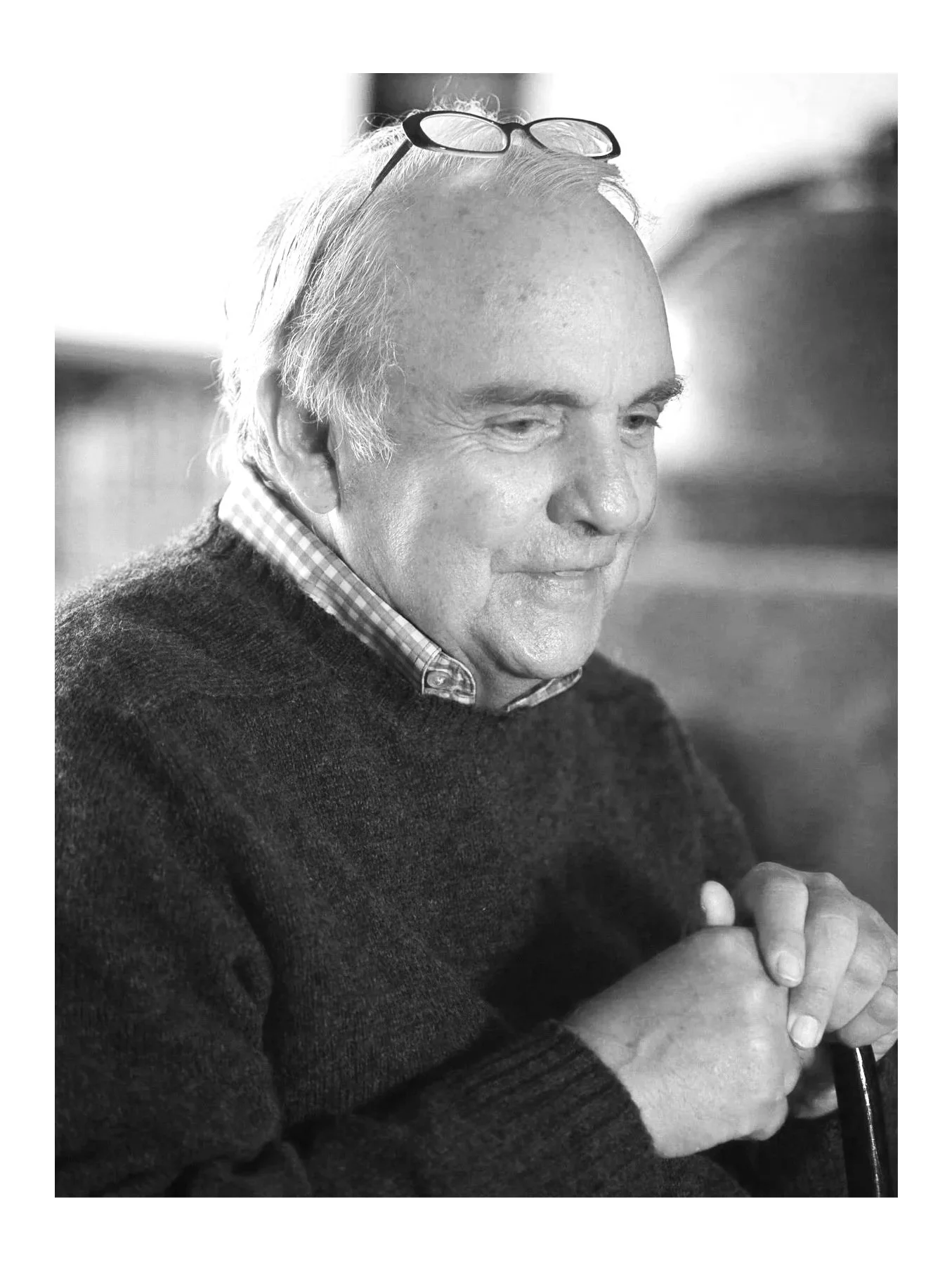
There is no cry from the human heart that he does not hear…[1]
In honour of Frederick Buechner’s hundredth birthday, I was going to write an elegant, researched essay on suffering and narration and the way that Buechner’s life and work combined the two.
Instead, I sit in a hospital room on the second floor of a great, blank-faced building and watch the suffering of my little son. We’ve been here for days, a high fever complicated by a genetic condition with which he was born. The light, filtered down from a sky I can barely see, is dull over his pale face. The walls around us are painted a too-bright yellow, a forcedly cheerful colour that cannot drain this space of the angst it routinely beholds. He sleeps for now, despite the odd collection of voices and beeps and alarms, the strange electric whirs that have been going, like the birds, since dawn, but bear none of their sweetness and lift to us here.
There is a certain quality of vision that comes to you in moments of desperate love. Your senses gather in sudden intensified attention. My son is heavy and hot in my arms. I count his eyelashes. Notice the pattern of his pores, the rills of his blond, damp hair. I am all here in this moment, no part of my mind off wandering or working somewhere else, here where the preciousness of him is a weight almost more than I can carry. While his breath, his shallow, hot breath, is so light. My son, my little son.
Who shall tell the tale of our anguished love in a broken world? Who shall help us to make a story from the jagged fragments of our sorrow?
Well, Frederick Buechner, I suppose.
This essay won’t be elegant any more, written as it is with a sweaty baby in the crook of one arm and a cardboard cup of coffee near the other. But if I have a tribute to offer Buechner as a writer, it is still and always that he taught me, he asked me, to see the most anguished portions of my life as the place, not of God’s abandonment, but of his arrival.
Suffering comes to us like the dark end of a tragic account, the dank, enclosed space in which narrative movement is no longer possible. What if the story of my son’s life ends here? Can my hope survive the sorrow I fear? What Buechner dared was to weave sorrow into story by pressing into the pain, by listening, by speaking the brutal truth of anguish in order to find the older truth of joy at work in its very heart. He had to do this work first for himself, but then, with astonishing generosity, he offered the tragic and comic and fairy-tale account of his own most anguished moments to his readers. He allowed us to witness his unravelling and share the story of his renewal: an act decidedly Christ-like.
There is a cruciform shape to the work of a Christian writer in this world and Buechner held it with absolute grace. To be a writer of faith you have to stand with feet stuck deep in the faulty earth of which you are formed and give bare, honest witness to the fact of a world that crucifies its Maker and unravels everyone else. But generalities are not enough. If you would actually hope to haul your reader out of the pit of their murky sorrow, you have to offer some of your own anguish as rope. There is a real sense in which Buechner’s writing life began with the suicide of his father. His account of this loss in The Sacred Journey (1982) is one of the most beautiful and aching things I’ve ever read. With an examined, but unsentimental honesty, he admits that the world is brutal and dark, that terrible things happen and we cannot explain or escape them.
We needed him to say this.
Much of his work was shaped by his capacity to, in the words that titled one of his last books, ‘speak what we feel, not what we ought to say’ (taken from Shakespeare’s King Lear). He spoke what I, in my early mental illness was desperate for someone to say amidst the many platitudes, the assurances that everything would be ‘all right’. It was absolutely not right then, and it’s not right now in the grey buzz of a hospital room with my fragile little son.
But Buechner allowed me to ask the questions I thought God wouldn’t want me to ask and find instead that God yearned urgently for me to ask them – Where are you? Do you care? Why don’t you help? – so that he could give me the wondrous answers I didn’t dare dream. ‘Listen to your life,’ Buechner urged, don’t except the ‘boredom and the pain’,[2] because this is where God arrives in his gentle, heavenly defiance to unravel evil and take back his ever-precious world.
In Telling the Truth (1977), Buechner wondered if ‘there is anything more crucial for the preacher to do than to obey the sadness of our times by taking it into account without equivocation or subterfuge.’[3]
Without telling the brutal truth of our darkness, Buechner knew he could not tell the greater truth of God’s mercy. The one leads to the other. If we cannot be honest about our pain, we cannot perceive the presence of God’s mercy. So Buechner spent a writing life admitting our collective despair in order to kindle and assure our joy.
For the other part of that cruciform shape a Christian writer must take is that of outstretched hands. The opened arms of imagination, reaching for the goodness before the grief, fingertips stretched to catch the edge of the healed world to come, and in that reaching, creating a circle of consolation in which readers may shelter. A writer’s arms suggest a little of the mother’s embrace (‘there, there, it’ll be all right’) or the lover’s (‘you are, possibly to your amazement, cherished’). The work of a writer is a little like that of the Psalmist’s when he helped us to imagine God tucking people up under his wings. The writer gives word to what the heart craves and leads the mind to the possibility that it might be true.
In that sense, a writer’s outstretched arms are like angel wings, those of God’s messengers arriving to upend and retell the grieved stories we bear about the world. Perhaps, they are particularly like the wings of the archangel Raphael, whose name means ‘God has healed’, and who happens to be the protagonist of one of my favourite, and far-too-little known of Buechner’s novels. Amidst the uproar and uncertainty of these days in the hospital, I’ve returned in snatched moments to Buechner’s brief, beautiful tale in On the Road with the Archangel (1997). It lies on the bed where I sit for hours, holding my son, waiting for the next test result, the official prognosis.
I pick it up when boredom overwhelms me and enter again Buechner’s retelling of the apocryphal story of Tobias and the archangel Raphael. Early in the book, we are introduced to a host of characters who (like me at this moment) hold a basic belief in ‘the Holy One’ but ‘would never have dreamed that the Holy One might feel as sorry for them’[4] as they did for themselves. The book opens with two people asking, from the depths of their pain and loneliness, to die. Raphael is sent to answer their shared plea, not the literal one for death, but the real one at its root, to be freed from what seem the inescapable indignities of blindness and poverty and demon-possession. They dare not ask for the blessings they really desire, so they ask for death.
What follows is a story of what might be called shared imagination, in which we as the reader are invited to imagine along with Buechner, how kind and merciful God might actually be despite our habitual assumption of his general grumpiness towards us and loftiness in our times of need.
The story is narrated by the archangel, who takes the name Azarias (‘God has helped’) when he assumes human form in order to aid the young Tobias. Tobias, a charming but somewhat naive young man, has the gargantuan tasks of banishing the demon lover who afflicts his young bride, and restoring the lost sight and fortunes of his righteous but depressive father. What a setup. Who shall intervene?
An angel, it seems, a rather verbose messenger of the Holy One who begins his narrative by telling us that he regularly ‘shakes with laughter’ at the absurd way in which humans misinterpret the interventions of the divine.
We have the enjoyable position throughout the story of watching the familiar (to us, because we share the shortsightedness of Tobit and his crew) befuddlements of humans in doubt and fear while knowing that they are literally attended by angels, aided by the Holy One, with fairy tale endings mere pages away. We share the all-knowing oversight of Raphael, the teller of the tale. The great effect of this is that we, as readers, begin to fall in with Raphael’s astonishing views of God. We begin to feel, with him, that it’s ridiculous for humans to believe God is up in heaven counting the tiny pennies of our confused attempts at prayer or piety and holding them against us. How absurd, these humans, made in the Holy One’s image after all, incapable of seeing kind he must be, how merciful and near. The very flowers sing it out. The very dog who pants in faithful love at Tobias’ heels is an image of his mercy.
Thus, Buechner weaves his enchantment. For a moment, for the space of our reading, we begin to assume the pervasive, luxuriant love of God to such an extent that we may laugh, and revel, and depend upon it. I begin to believe it, even in the grey enclosure of my son’s illness. We begin to pray under our breath in a ceaseless, heavenward rumination as Tobit does toward the end of the book when he wanders out deep in the dark night to sit on an overturned rain barrel and contemplate his story.
His prayer is narrative at first, as our has been in the company of Raphael, touching upon each point of pain and grace and doubt in the story of his healing. Somewhere amidst it, he remembers that God really is supposed to be merciful above all else, and he tries to ‘concentrate’ on that fact, a work that makes him want to share this idea with the rest of his suffering people. This desire to comfort blossoms into prophecy as his dreams runs away with him into such wild ideas as the nations streaming in to worship the Holy One with gifts in their hands, or the end of his people’s captivity. He lets his imagination ‘run wild’ and imagines Jerusalem restored and ‘built with sapphires and emeralds and her towers and battlements with pure gold’. The zenith of his prayer is when he imagines:
The new Jerusalem coming down out of the sky as fresh and lovely as Sarah coming down out of the cart in her blue dress when she first arrived at Ninevah as a bride […].[5]
This image, says Raphael, is ‘as close as he got to the actual truth of things’[6] — and perhaps us with him as well.
But, of course, it’s really Frederick Buechner saying those things. It’s really Buechner who has been the angel God sent to heal our ridiculous notions of divine abandonment or of a divine displeasure so great that he would ignore our pain. It’s Buechner who helps us to see that the Holy One is ‘forever dispatching angels of light to deal with them mercifully’,[7] to deal with us in a creative, story-renewing mercy that narrates us back into the story of healing that God is telling throughout his suffering world.
A nurse has just come in the room as I write. It’s time for checks – pulse, temperature, blood pressure (always a wrestle with a baby). She fumbles with a cord, and it drops. ‘Jesus,’ she says in frustration. I hold Jack as still as I can while she attempts to tie the pulse reader to his big toe for the third time. ‘Jesus,’ she breathes as, yet again, it slips.
And a real squawk of laughter almost escapes me.
Jesus. Of course he’s here. Here where my prayers seem to end at the ceiling, here where the person speaking his name has no idea of his reality. Jesus, here with my fevered child, tethered to monitors and drips, his happy eyes dimmed by exhaustion. Buechner, in his guise as an angel, slips in even here to remind me of the fact. His words weave between the beeps and cords and sterilities that attend us with the assurance that the Holy One ‘wishes the world and its creatures nothing but well’.[8]
His story tells me out of darkness and into the great light of the good tale God is still telling for me and my son. I am drawn by the hand out of the fear by the words of this generous writer. His tale helps me to believe that God will see us safe through every tumult and grief of this world. We aren’t abandoned as I too often fear. There are tears in my eyes, but I’m with Raphael, with Buechner: mirth, spacious and sweet and wild, is burgeoning in my heart.
It is, perhaps, the best tribute I can give to the good and mirthful Mr. Buechner.
Thank you for reading the hundredth birthday edition of The Buechner Review. Should you wish to join the celebrations on your own social media pages by sharing a tribute to Buechner with the world, we would encourage you to do so beneath the hashtag: #fb100.
Devoted to the aim of giving each human reader a real encounter with a human author, the Review asks its contributors to refrain from using AI in the composition of their prose.
If you would like to receive future articles in your email inbox you can sign up here.
Works cited:
[1] Frederick Buechner, On the Road with the Archangel (New York: HarperSanFrancisco, 1997), p.117.
[2] Frederick Buechner, Now and Then: a memoir of vocation (New York: HarperCollins, 1983), p.87.
[3] Frederick Buechner, Telling the Truth: the Gospel as tragedy, comedy, and fairy tale (New York: HarperSanFrancisco, 1977), p.7.
[4] Buechner, On the Road with the Archangel, p.48.
[5] Ibid, p.135.
[6] Ibid, p.135.
[7] Ibid, p.135.
[8] Ibid, p.135.
Sign up here to receive articles in your inbox
