i. Voyages
In 1855, an artist and writer based in New York embarked on a voyage up the Hudson River to the Adirondack Mountains. ‘The comfort and quiet of this mode of conveyance is beyond all that I have hitherto experienced traveling by water. There is neither the smoke nor clatter of steamers.’ In the writer’s description of the experience, the view of the city over his shoulder receives hardly a mention. The sun was a ‘yellow haze,’ and the water ‘a flood of molten gold, streaked with blue where the sails of the vessels intervened.’[1]
William James Stillman sought solitude for the sake of personal renewal, but like Thoreau before him (Walden was published the previous year), he was also enacting a new cultural script. In the context of industrialism and its discontents — there was no Sabbath to be found in the city — the literati turned to nature not only for refreshment but also as a source of divine revelation. Landscape artists who joined Emerson in making nature ‘the present expositor of the divine mind’ became priests of sorts.[2] As a member of this new priesthood, Stillman knew exactly what he was doing.[3]
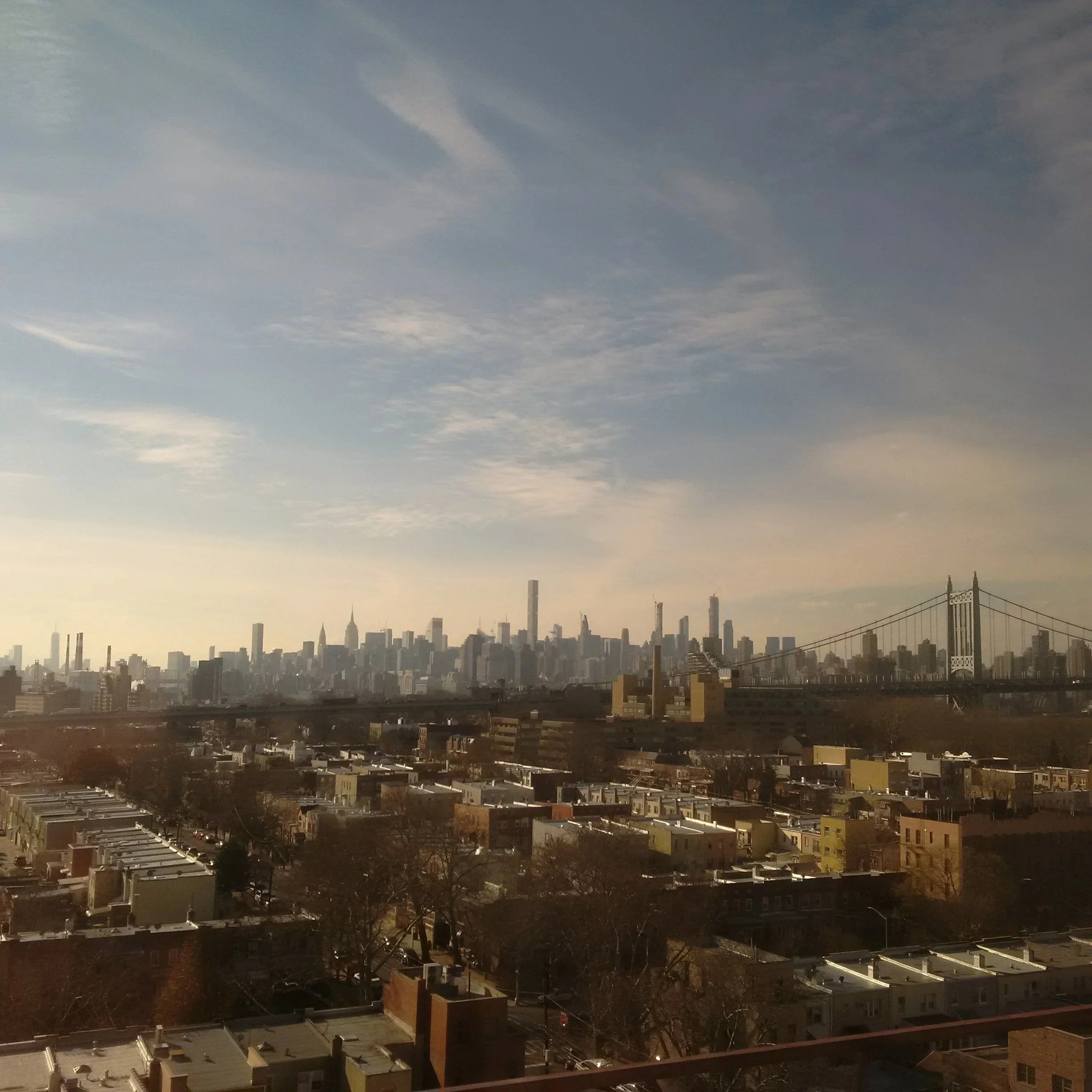
Over a century later, another writer from the New York City area crossed the Hudson River into the city. Like Stillman he was a keen observer, very sensitive to his surroundings. ‘The sky was cloudless and blue,’ Frederick Buechner wrote, describing the beginning of a journey from Newark to Manhattan via the Lincoln Tunnel. Suddenly, there appeared a figure in his field of vision. Just a few hundred yards away, a huge airplane landed at Newark International Airport. Instead of ignoring it or complaining about it, he incorporated it into his rhapsodic account of the view through the windshield.
The sermon that Buechner gave about this experience offers a wider lens of appreciation than the one utilized by Stillman and his fellow Romantics. By finding beauty not only in the country but also in the city, he encourages a more imaginative way of seeing and a more hopeful way of being.
ii. Idyll Interrupted
To understand Buechner’s literary maneuver and motivation, we would do well to note the ways that antecedent texts dealt with abrupt intrusions upon the senses of sight and sound. ‘I hear the whistle of the locomotive in the woods,’ Emerson wrote with concern in 1842. In 1844, the same year Wordsworth penned a poem protesting the ‘assault’ of a railroad in the Lake District, Hawthorne — while enjoying the silence and solitude of the woods near Concord, MA — registered alarm: ‘But, hark! there is the whistle of the locomotive.’ Thoreau, residing nearby, similarly reported the Fitchburg Railroad ‘snort like thunder, shaking the earth with his feet, and breathing fire and smoke from his nostrils.’[4]
The sudden invasion of a pastoral scene by a locomotive or a steamboat, as we find in Huckleberry Finn, is a motif that literary critic Leo Marx called the ‘interrupted idyll’ — and in the context of the American pastoral tradition of Hawthorn, Melville, Thoreau, and Twain, the trope serves a fairly specific purpose. The narrative structure of this literature unfolds in three movements: a retreat or withdrawal from society, a search for happiness and simplicity amidst the idyllic beauties of nature, and finally the hero-narrator’s return to society. These movements, in turn, map onto the journey within, beginning with alienation from civilization and society followed by the search for serenity and freedom from anxiety. The interruption, which occurs in this second and central movement, introduces the narrative tension.
What to do? Chase the receding frontier? Return to civilization, conceding the inevitable advance of technology? Or perhaps seek a compromise, a new resolution between nature and culture? The steam engine makes it loud (literally) and clear that withdrawal is no solution at all, for separation from society is no longer possible.
Although the motif raises enduring human questions, the power and prevalence of it in American literature is hard to overstate. In the context of the New World and the new republic, the question of whether and how civilization should continue to colonize vast, open landscapes was not just a literary experiment, as evidenced by Thoreau’s retreat to Walden and Stillman’s journey to the Adirondacks.[5] For Jeffersonian agrarians, who borrowed the pastoral ideal from literature and applied it to politics, the collapsing distinction between city and country posed not only aesthetic but also moral problems. The cultural stakes ran high, for the idyll being interrupted was not merely aural and visual but existential.
Can we make peace with the Machine?[6] Hawthorne, for one, found little room for compromise. The locomotive remained for him a metaphor for alienation, the shriek of steam engines symbolizing an ‘unquietness’ within, and especially within ‘men of business.’[7] Although he briefly attempted a reconciliation of factories with a picturesque aesthetic, he later ‘conceived the idea of a malignant steam engine which attacked and killed its human attendants.’[8]
Others were not quite so pessimistic. In 1854, the same year as the publication of Walden, the Lackawanna Railroad Company commissioned George Inness to paint a picturesque scene incorporating a locomotive and its roundhouse. Although he initially resisted, in the end his The Lackawanna Valley successfully and seamlessly integrated the steaming engine into the landscape.[9] It suggested a reconciliation of sorts, even if an uneasy one.
Romantic responses to technology thus ranged from ambivalence to horror. What they shared, however, was a sense that full reconciliation between nature and culture, self and society, was always just out of reach. That is what makes Buechner’s airplane so interesting.
iii. What would Buechner do?
If Buechner had sat where Hawthorne or Huck Finn were perched when steamships and steam locomotives invaded the land, how might he have responded? His response to the plane gives some indication.
Far from jarring him out of his reverie regarding the big blue sky, Buechner incorporates the plane into his perception of the scene’s beauty. ‘[A] huge silver plane traveling in the same direction as I was made its descent in a slow diagonal and touched down soft as a bird on the airstrip just a few hundred yards away from me as I went driving by.’[10] The appearance of the plane widens rather than narrows the aperture of his appreciation.
He finds fascination not only with planes, which used to be called “flying machines,” but also with automobiles, originally called simply “machines.” Although the city was ‘snarled and seething with traffic as usual,’ he simultaneously sensed something beyond the usual. He didn’t see anything new, but he saw all things anew, including and especially the most mundane of all: ‘It was gorgeous traffic, it was beautiful traffic.’ And he experienced a transformation not only of vision but of the senses more generally: ‘It was a beauty to see, to hear, to smell, even to be part of. It was so dazzlingly alive it all but took my breath away.’
Then there were the people, the machine-makers. The city ‘rattled and honked and chattered with life — the people, the colors of their clothes, the marvelous hodgepodge of their faces, all of it; the taxis, the shops, the blinding sidewalks.’ And not just some persons but all persons: ‘The spring day made everybody a celebrity—blacks, whites, Hispanics, every last one of them. It made even the litter and clamor and turmoil of it a kind of miracle.’ On 54th Street he spotted a ‘wino’ (as we used to say), ‘stretched out on his back in the sun on a pile of lumber as if it was an alpine meadow he was stretched out on and he was made of money.’
Like Stillman before him, Buechner knew exactly what he was doing. As a man of letters, he surely knew the trope of the interrupted idyll, or what Marx sometimes called ‘the machine in the garden.’ But he doesn’t follow the received script because he sees the world differently, and he wants his readers to as well. Whereas the Romantic tradition finds signs of divinity primarily in natural objects and is therefore skeptical of machines (and tends to obscure human figures), Buechner finds signals of transcendence everywhere he looks — in nature, in culture, and in all humanity.
This is not sentimentalism. Buechner is not blind to ‘the dirt and noise and crime and poverty and pollution of that terrifying city.’ But, at the same time, his vision is not limited to material reality. ‘For a moment it was not the world as it is that I saw but the world as it might be.’ I don’t know if this counts as Romanticism, but if it does, it is a more capacious and expansive Romanticism.[11] In any case, it suggests a sacramental vision that perceives divine grace in more than just nature.
iv. Frederick Buechner and me
For a variety of reasons, anti-urbanism has long had a purchase on the American mind, including my own mind. Hailing from suburbia, which Marx calls a ‘debased and doomed version of the pastoral retreat,’ I fled the New York area immediately upon finishing high school and bicycled out west for the entire summer.[12] Somehow, at seventeen I already needed to get away from it all — to ‘Back out of all this now too much for us,’ in Frost’s famous phrase. For university, I again escaped the metro area, this time northward to the rural environs of upstate New York where I took up climbing and backcountry travel.
Not only did I take to the woods à la Stillman and Thoreau, but I made a living taking others to the woods for many years. In the great outdoors, life is simple even if not always easy — hike, climb, cook, eat, clean, sleep, and repeat — and I often felt most at home when away from home. Upon emerging from Shoshone National Forest after 21 days in Wyoming’s remote and rugged Wind River Range, the sight of the four-wheel driving machines in the parking lot utterly depressed me. Oh, to turn back and extend my holiday from history.
I have had plenty of occasion to ponder why Thoreau and friends so thoroughly captured my imagination, and I am tempted to blame my anti-urbanism on New York City, one of the dirtiest and most dangerous cities in the world during my youth. The blackout of 1977, during which the city plunged into a chaos of arson, looting, violent crime, homicide, and thousands of arrests, captured the atmosphere that lingered into and through the eighties. When in 1981 I ventured into Central Park to hear Simon and Garfunkel’s now legendary concert, the duo performed Garfunkel’s brand new single “A Heart in New York.” The ballad, not unlike Buechner’s sermon, begins with a landing plane alighting upon the city, but the perspective is from the air. Half a million New Yorkers roared in a moment of collective self-recognition when their beloved park was wistfully serenaded like a lost lover. ‘New York, lookin' down on Central Park / where they say you should not wander after dark.’[13] Indeed, Mark David Chapman had murdered John Lennon there nine months earlier.[14]
Simply put, what industrialization and the steam locomotive did for Emerson and Thoreau, urban blight and the bombed-out South Bronx did for me. Who would not want to get away from New York City during the dreadful years of the Koch administration?[15] Frederick Buechner, for one.
Remarkably, the New York I abhorred was the very same New York that Buechner apparently adored. I have had many guides in my long, slow process of deprogramming the anti-urbanism of my youth, but perhaps none better than Buechner.
v. Reconciliation
Before encountering Buechner, I first became persuaded that society is inescapable by the American mountaineer and philosopher Willi Unsoeld, who famously argued that we should seek the sacred in nature not for its own sake but precisely so that we can cope more effectively with the problems of the city.[16] I should have learned this earlier, for the return to civilization — the third movement in Marx’s motif — is found throughout Romantic art and literature. The collective testimony of Walden, Moby Dick, and Huckleberry Finn, as well as the twentieth-century works of Frost, Fitzgerald, Hemingway, and Faulkner, is that withdrawal from society provides only a temporary satisfaction — ‘a momentary stay against confusion,’ as Frost put it.
The hope, according to Marx, is that ‘regenerative power is found in the natural terrain’ that, upon return, leads to reintegration.[17] ‘Has the hero been redeemed? Is he prepared to take up the common life?’ More often than not, the resolution is ambiguous and the hero ‘remains a forlorn and lonely figure.’[18] In response to the question ‘How can he carry back into our complex social life the renewed sense of possibility and coherence that the pastoral interlude has given him?’ Marx writes, ‘None of our writers has been able to find a satisfactory answer to this question.’[19]
I still enjoy the literature and especially the landscape art of this period, though perhaps not quite as much as I once did. To be sure, I resonate with worries about society and technology, with the concern that, in Emerson’s words, ‘Things are in the saddle and ride mankind.’[20] I resonate also with the Romantic longing to seek solace in nature, and even with the reluctance to return to civic responsibility. And yet, as much as I love the natural world, I wonder whether Romanticism asks too much of it.
This brings me back to the decidedly non-forlorn Frederick Buechner. ‘I had music on the radio,’ he wrote, ‘but I didn’t need it. The day made its own music — the hot spring sun and the hum of the road, the roar of the great trucks passing and of my own engine, the hum of my own thoughts.’ Not only is his movement into rather than away from the city, but no noise, not even the noise within, interrupts his idyll. The cacophony of that ‘terrifying city’ can’t touch his serenity.
Buechner here comes across as more romantic than the Romantics, perhaps even a purveyor of a new and better Romanticism. Everything and everyone takes him deeper into his experience of renewal and of seeing all things renewed. Grace reveals itself through all landscapes, including the cityscape replete as it is with craft, engineering, and machines of all kinds. And grace reveals itself not only through beauty but also through brokenness.
What Buechner saw, he would have us believe, is the Kingdom of God — a time ‘when it will no longer be humans in their lunacy who are in charge of the world but God in his mercy who will be in charge of the world.’ Buechner writes that, far from being a dream, this experience was ‘as if I had woken up from a dream. I had the feeling that I had never seen the city so real before in all my life.’
The world as it might be, he says, is the real world, and to see others and the world in this way is to catch a glimpse of glory. The glimpse may be temporary, but the hope it provides is concrete. The mood, accordingly, is not melancholy. ‘The city was transfigured,’ he writes. ‘I was transfigured.’ Reintegration, far from being ambiguous or out of reach, is promising and even in process. Such a transfiguration of vision is neither a discovery nor an accomplishment but a gift.
Although the relationship between aesthetics and ethics, or vision and virtue, is beyond the scope of this essay, such a transformation of vision is eminently practical. If we could see others not only as they appear to be but as they really are, then many social and political problems would resolve themselves. The same is true, of course, regarding both our built and natural environments.[21] I was prepared to love New York as soon as it became clean and safe — in a sense, as soon as she loved me. Buechner, by contrast, loved New York while she was yet dirty and dangerous, clothed in filthy rags. Conditional and unconditional love, it turns out, are very different things.
When I think of the implications of Buechner’s vision, of what the world would be if we could only see it as it really is, I am reminded of Joseph Sittler’s provocative claim that ‘Piety is deepest practicality, for it properly relates use and enjoyment. And a world sacramentally received in joy is a world sanely used.’[22] I still enjoy Stillman and Thoreau, but I aspire to see — and to be — more like Buechner.
AUTHOR’S NOTE: This article is dedicated to the late Richard A. Baer Jr., who taught Environmental Ethics at Cornell University for 30 years.
EDITOR’S NOTE: Thank you for reading The Buechner Review. If you would like to receive future articles in your email inbox you can sign up here.
Works cited:
[1] W. J. S., Flake White and S. L. G., “Sketchings.” The Crayon 2, no. 14. (October 3, 1855), pp.216-218.
[2] Ralph Waldo Emerson, quoted in Leo Marx, “Pastoral Ideals and City Troubles,” The Fitness of Man’s Environment (New York: Harper & Row, 1968), p.126.
[3] Stillman was a Romantic of the Pre-Raphaelite variety — he admired art critic John Ruskin, befriended transcendentalist philosopher Ralph Waldo Emerson, and studied under Hudson River School luminary Frederick Church. The definitive biography is Stephen L. Dyson, The Last Amateur: The Life of William J. Stillman (Albany: State University of New York Press, 2014).
[4] Throughout this article, I draw on various works by Leo Marx. Excerpts quoted in this paragraph are from The Machine in the Garden: Technology and the Pastoral Ideal in America (London: Oxford University Press, 1964), chap. 1.
[5] The retreats of Stillman and Thoreau, though both oriented toward seeking wisdom in the natural, are nevertheless distinct. While Thoreau remained close to civilization, Stillman’s venture was much more rugged and remote. As with the tension between primitivism and pastoralism in art, Stillman’s primitivism and Thoreau’s pastoralism occasioned tension between the two writers. Stillman, for example, called Walden a ‘barn-door backwoods.’ James Schlett, A Not Too Greatly Changed Eden: The Story of the Philosophers' Camp in the Adirondacks (Ithaca, NY: Cornell University Press, 2015), p.148. Poet James Russel Lowell, in an essay critical of Thoreau, compared him unfavorably to Stillman, the latter being ‘a genuine solitary who spent his winters one hundred and fifty miles beyond all human communication, and there dwelt with his rifle as his only confidant.’ Dyson, Last Amateur, p.84.
[6] There is a long tradition invoking the Machine as a metaphor, for example, as ‘a systematic organization of scientific discovery and technical invention that, under the pressure of excessive pecuniary gains and exorbitant political powers, has transformed the entire existence of the Western World.’ Lewis Mumford, “Constancy and Change,” The New Yorker, March 6, 1965, 162. See also Paul Kingsnorth, Against the Machine: On the Unmaking of Humanity (New York: Penguin Group, 2025).
[7] Marx, Machine, p.24.
[8] Leo Marx, “The Machine in the Garden,” in The Pilot and the Passenger: Essays on Literature, Technology, and Culture in the United States (Oxford: Oxford University Press, 1988), p.119, p.115.
[9] George Inness, The Lackawanna Valley, c. 1856, oil on canvas, National Gallery of Art, Washington, D.C.
[10] All Buechner quotes are from his sermon “The Kingdom of God,” in The Clown in the Belfry: Writings in Faith and Fiction (San Francisco: HarperCollins, 1992), pp.165-168.
[11] I use Romanticism primarily as enthusiastic ‘sensibility to natural objects,’ though it is arguably ‘a word of such varying senses that it has become useless and should be banished from our vocabulary.’ C.S. Lewis, Pilgrim’s Regress: An Allegorical Apology for Christianity, Reason and Romanticism, 3rd ed. (Grand Rapids: Eerdmans, 1943) p.5-6.
[12] Leo Marx, “Pastoral Ideals and City Troubles,” in The Fitness of Man’s Environment (Smithsonian Annual II) (Washington, DC: Smithsonian Institution Press, 1968), p.141.
[13] Simon & Garfunkel. “A Heart In New York,” The Concert in Central Park, Legacy Recordings, 1982. For a variation on the “machine in the garden” theme, see Simon’s underrated “Train in the Distance,” Hearts and Bones, Warner Bros. Records, 1983.
[14] One irony regarding violence in the park is that Frederick Law Olmsted, who designed Central Park in 1858 — the same year Emerson and Stillman camped together at “The Philosophers’ Camp” in the Adirondacks — conceived of the park project primarily in terms of moral reform. Consider, for example, Olmsted’s clever design feature of submerged transverse roads, which, like the obscuring of human figures in Hudson River School paintings, are designed to draw the eye to uplifting, natural scenery.
[15] Mayor Ed Koch served from 1978 to 1989. By 1990, the murder rate in New York City peaked at over 2200. According to official data, which surely understates the problem, there were over 400 instances of stolen motor vehicles (grand larceny auto) daily. https://www.nyc.gov/assets/nypd/downloads/pdf/crime_statistics/cs-en-us-city.pdf.
[16] Originally a keynote address presented at the 1974 Association of Experiential Education Conference. See Willi Unsoeld, “The Spiritual Values of Adventure,” in The Theory of Experiential Education, ed. Karen Warren, Mitchell Sakofs, and Jasper S. Hunt, 3rd ed. (Boulder, CO: Association for Experiential Education, 1995), pp.385–91.
[17] Marx, Machine, p.228.
[18] Marx, “Pastoral Ideals,” p.124.
[19] Marx, “Pastoral Ideals,” p.138.
[20] Thoreau, in a similar vein, wrote ‘Men have become the tools of their tools.’ Marx, Machine, p.247.
[21] See Richard A. Baer, Jr., James A. Tantillo, Gregory E. Hitzhusen, Karl E. Johnson, and James R. Skillen, “From Delight To Wisdom: Thirty Years of Teaching Environmental Ethics at Cornell,” Worldviews 8, no. 2–3 (2004): pp.298–322.
[22] Joseph Sittler, quoted in Ellen F. Davis, Scripture, Culture, and Agriculture: An Agrarian Reading of the Bible (Cambridge: Cambridge University Press, 2009), chap. 6.
Sign up here to receive articles in your inbox
