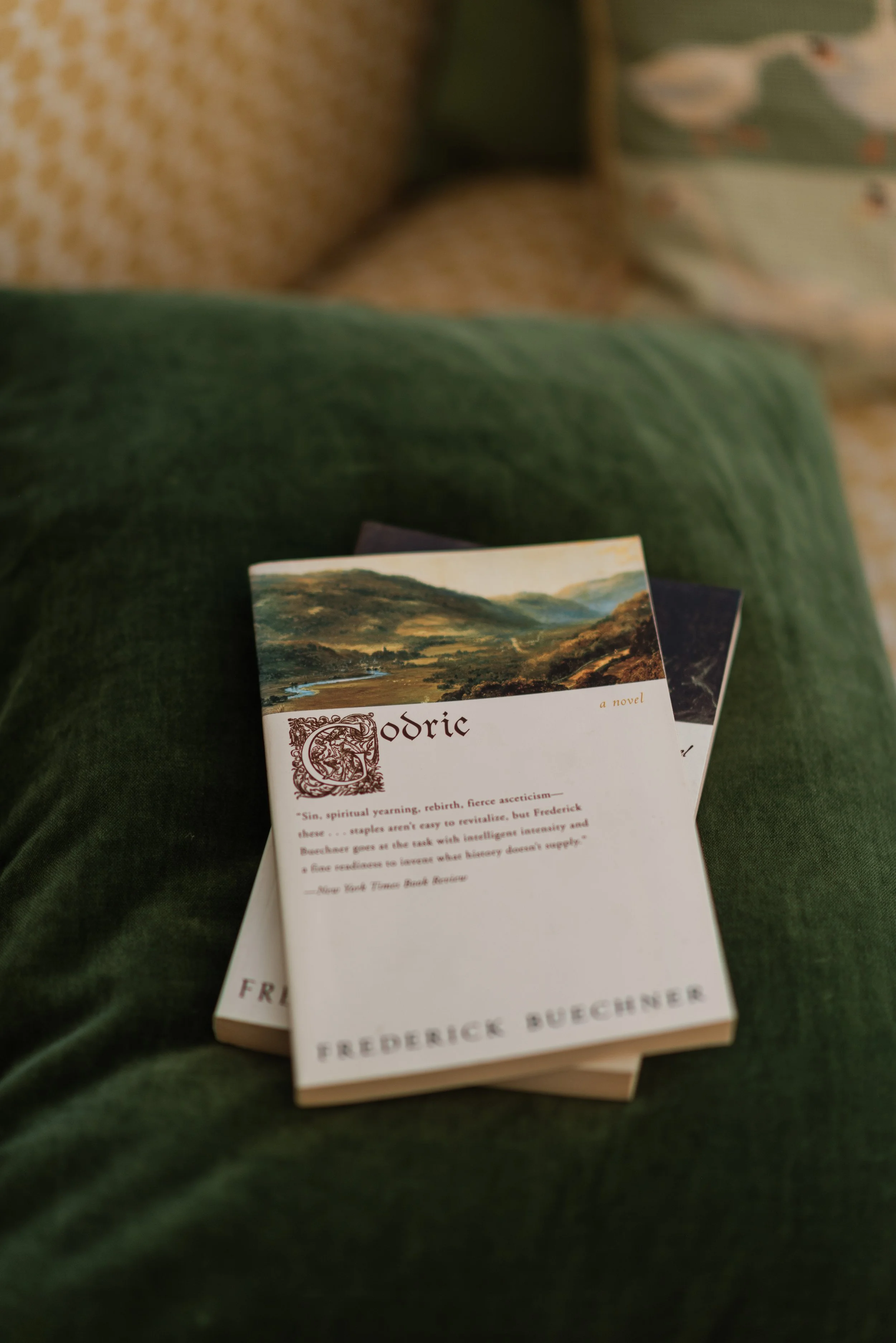
When I think of the introduction of Frederick Buechner’s Godric (1980), I see a man dripping with water, though Godric himself is mainly occupied with describing his five friends. The image of Godric “puddling [his] way home like a drowned man from dark Wear”[1] is one of the first vivid details he offers to us, and in the frame are two characters: the protagonist and the fluvial companion who will appear numerous times throughout the tale.
The River Wear sings to Godric in a dream long before he ever sets foot on its banks. It will be the site of his hermitage, he knows then, and once he finds it, he takes to sitting in the river “each day, for years and years.”[2] Even when he is no longer able to walk easily, buckets of Wear are brought to a hollow in a little church Godric has built, and he sits immersed in its waters or else sits beside them to look down “till within [Wear’s] depths [he sees] a star.”[3] Godric observes Wear wild and frenzied with snowmelt one year, its form swollen thunderous with rain until the land floods and the old saint is forced to take refuge with his friend Ailred on the roof of the church “to croak the time away till Wear [grows] calm.”[4] Wear is witness to some of Godric’s most regretted sins. It is the site of glad occasions such as the baptism of the boy he considers his son and by the midpoint of the novel it is clear that Godric counts the river as an active character:
It rattles stone on stone. It sucks its teeth. It sings. It hisses like the rain. It roars. It laughs. It claps its hands. Sometimes I think it prays. . . . It tosses fallen trees like bits of straw yet spins a single leaf as gentle as a maid.[5]
On the day that Godric suffers a stroke and knows he will die, he desires one thing: “I crave to wash once more in Wear.[6]
Godric’s impulse to be in the old river is no sterile symbol of purgation; it is the honest reaction of a life lived within sight and earshot of its movement. Though he likens rivers to time earlier in the book,[7] by the end Godric’s own river gestures towards a mystery greater than the phenomenon of years flowing by. In the burble and wash of Wear one catches something betokening near-senseless and ever-present mercy, a force that often accomplishes in Godric what Godric himself cannot. Even in his last hour on its banks, unable to speak or control his body, Godric finally blesses the hapless scribe who has been the target of his scorn and contempt and impatience through the entire narrative: “If I could move my hand, I’d reach and lay it on his monkish pate. If I had legs I still could bend, I’d kneel to beg that he forgive me all the years I’ve used him ill.”[8] Godric does not merely bless Reginald here; he wants to bless him. It may be that, in some sense, Godric could only extend his benediction after this final river-washing—the culmination of grace after grace received, like his daily immersion, overflowing at last into a mighty grace bestowed.
The last acts of Godric are thus set in a fitting place, and his dying turn to Wear is the most natural response a reader could imagine.
*
When I read Godric for the first time earlier this year, I was thinking about natural responses. Numerous situations in and around my life felt strangely like car crashes happening in slow motion. Those who could see and dread the coming disaster could do very little to avert it, and those who had the power to change the outcome seemed to have no interest in doing so.
In the midst of this, a friend and I had a conversation about the imprecatory psalms. I had always been slightly uneasy about their existence, their graphic calls for divine action upon their enemies—but for the first time, they started to make sense to me. We live in an age of broad access to the opinions and motivations of others, and they are legion; in the comments to almost any post or article, I can find the world defined according to political power, monetary success, generational differences, and critical cachet built upon disdaining others’ creative efforts. These replies cheer power, expansion, domination, “good taste,” bluntness; at times they go so far as to applaud retribution, dishonesty, and the trampling of fellow souls. Doomscrolling for me is often an exercise to see how roundly I can become disoriented on a given day.
In such a crowd, the imprecatory psalms stand out as a compass. With vulnerability they turn our attention to injustice and cruelty, and show us what our response to them ought to be: how wrongdoing and evil and contempt—sometimes in our enemies, sometimes in ourselves—ought to smite us to the heart, how strongly we can and should recoil, how earnestly we should seek justice. I’ve come to believe these psalms are present in Scripture to show us the magnitude of our brokenness, our sin, the things we are capable of doing to each other, and the proportionate response that these things actually deserve. These poems speak from a place of conviction beyond cool rationality.
In Christ I see the same, particularly when he weeps over Lazarus. He wept though he could see the resurrection in the next hour and the redemption that would offer healing to not merely one man but all mankind; he wept, not as a hat tip to grief, but because it was the only sane response to Death and the sorrow of the ones who loved Lazarus. It was the reaction of a fully formed human, which is what Buechner also calls Christ:
“Behold the man,” Pilate said when he led Jesus out where everybody could see him. He can’t have been much to look at after what they’d done to him by then, but my guess is that, even so, there suddenly fell over that mob a silence as awed as ours in the forest when for the first time in their lives they found themselves looking at a Human Being.[9]
The tears of Jesus are, I believe, the epitome of a human’s right and natural response.
And these days, I grieve that I am not always capable of such tears.
The slow-motion car crashes keep occurring, taking the form of catastrophes that I can only listen to and cannot solve. I am a witness to geographically local and distant suffering that I cannot, cannot alleviate. Data that I did not consent to share is constantly being scraped and compromised by agents without a face. I keep seeing in myself and others the inability to connect the dots from what we consume to the ways that those goods are linked to the exploitation or harm of other living beings, in places ranging from farm fields to data centers, but I see too that those who seem most blind are often holding body and soul together by the skin of their teeth. Deadened and seared by daily reports that cannot simply be ignored, I’ve noticed there are times now when I fumble for words and forget how to feel; I become dull, incapable of any coherent response at all.
I would like to be able to rise from this place of continual lament. I would like to be a person who has natural responses that are right responses, by which I mean responses of the kind my Lord would give. But how does one infuse life into immovable limbs? What mercy can make me soft and strong and hale enough to embody Christ in the torrent of these days?
*
Buechner takes the long way around to answer my questions. I am in a better place now to understand his route than I was in my early twenties. Back then, I made an effort to anticipate questions and have the right answers ready in case anyone ever asked me about Christ, the gospel, Christian doctrine, or apologetic arguments. Over time I came to realize that either I could become a directory of specific answers or, perhaps, become the kind of person from whom answers sprang organically out of a living faith, even if those answers were imperfect and inadequate at times.
The latter requires transformation of the whole person, which is what Buechner says is the only way to come near to God. He writes:
[Jesus] didn’t say that it was by believing or doing anything in particular that you could ‘come to the Father.’ He said it was only by him—by living, participating in, being caught up by the way of life that he embodied, that was his way.[10]
The way we come to the Father, the way we become like Christ, is a process that involves our whole being. Nothing is exempt.
In fact, twice Godric mentions his bowels in his memoir: once to say “it was not coldness but the warmth of Godric’s bowels for [his snake friends] that made him drive them off”, and once when, at the sight of his sister wasting away, his “bowels within [him] stirred for pity and remorse.” [11] Though the mention is strange to our modern sensibilities, the gut, the stomach, and the bowels took center stage in the medieval church’s earthy understanding of personhood. In this view, right natural responses have their origin in the gut, the core of our formation; the very word “visceral,” which we often use to describe instinctive and instant reactions, means “affecting the viscera or the bowels regarded as the seat of emotion.”[12] “I have never experienced stomach doubt,” Buechner states, “but I think Jesus did. When he cried out, ‘My God, My God, why hast thou forsaken me!’ . . . I think he had looked into the abyss and found there a darkness that spiritually, viscerally, totally engulfed him.”[13] Neither Buechner’s characters nor his view of the humanhood of Christ depend on learning the right responses to be performed by rote or consciously calculated from minute to minute. Artificial intelligence works this way; the development of a human does not. If I wish to have right responses, I must begin by bringing all of myself into the present, the emboweled “seat of emotion” included, and if I desire to have right responses all the time — then what I’m really asking for is holiness, and Buechner’s work invites me into this pursuit through (at least) three challenges.
First, Buechner underscores the importance of laying bare how we feel: to God, to ourselves, and eventually to others. He contrasts these emotions and our personal experiences with what we think we rationally ought to say — the words that are expected of us, the words that travel in a tight arc searching for a sanctioned place to land. To preachers he reflects:
One wonders if there is anything more crucial for the preacher to do than to obey the sadness of our times by taking it into account without equivocation or subterfuge, by speaking out of our times and into our times not just what we ought to say about the Gospel, not just what it would appear to be in the interests of the Gospel for us to say, but what we ourselves felt about it, experienced of it.[14]
To writers he says much the same. Speak What We Feel (Not What We Ought to Say) (2001), which borrows its title from King Lear, is a collection of short autobiographies of four writers in whom Buechner saw a common trait: writers well-acquainted with grief who dared to be “at their nakedest and most vulnerable” in at least one work, who “[put] their pain and their passion into their books.”[15] He believed that from this naked vulnerability could come succor for the sorrow that is common to all mankind — so much so that this is the unifying thread of the entire study.
To be so vulnerable, I must learn to name what I feel and not what I manufacture. I spent years when I was younger being careful, always mindful of the consequences of sharing too much or admitting too much even to myself, so I am still learning to explore the saw-toothed edges of unresolved sadness, to give voice to anger and frustration, to illumine the drab and gray corners of my melancholia. I am learning to gather up my impatience and self-centeredness, my anxiety and intrusive imaginings and instinct for self-preservation, and own up to their identity as the offspring of my heart. I lay them uncovered before Christ and wait to see his expression.
Only then can I be answered in the ways I truly hunger to be answered. Like C. S. Lewis’s character Orual, who was “forced at last to utter the speech which [had] lain at the center of [her] soul for years”[16] and then wondered how she could have ever expected a divine answer before that point — “How can [the gods] meet us face to face till we have faces?”[17] — the excavation of my emotions and thoughts is helping me uncover the core beliefs that ultimately drive my actions.
Second, Buechner regards our tears as a signal worthy of investigation. “Whenever you find tears in your eyes, especially unexpected tears, it is well to pay the closest attention,” he advises.[18] We are “hopelessly psychosomatic in composition,” he writes elsewhere,[19] and this means that sometimes our bodies react with tears of joy or sadness or another emotion before our minds catch up to figure out why. In the only place in Godric where for me Buechner’s voice seems to break the fourth wall, Godric makes inquiry into his tears as he and his mother visit Rome:
Why did we weep? I asked myself. We wept for all that grandeur gone. We wept for martyrs cruelly slain. We wept for Christ, who suffered death upon a tree and suffers still to see our suffering. But more than anything, I think, we wept for us, and so it ever is with tears. Whatever be their outward cause, within the chancel of the heart it’s we ourselves for whom they finally fall.[20]
What does it mean to weep for ourselves? My tears have begun to spring to the surface again, and earlier this week I knew that I had struck on a hidden grief and fear when they suddenly spilled onto my cheeks as I described a part of my past to my husband. Weeping, even happy weeping, brings a catharsis that reminds me we are integrated creatures — heart, mind, soul, spirit, skin, bowels, body — and the experience helps me to take better stock of the things that lie beyond my control.
When I lament today: am I grieving the hardness of the task before me? Am I expressing my reluctance to be led where I do not want to go? Do I fear that another’s pain will batter their spirit beyond recovery? When I rejoice today: what is the beauty or poignancy that moved me? What, as it turns out, did I need to be reminded of? What facet of my long-held hope was revived? Where, O soul, did it come from?
What truths can be told by the water that interrupts my sight?
Third, Buechner spurs us to consider the wideness of the mercy of God. In my view, this is where he excels, whether he is talking about himself or a protagonist, almost to the point where I have to flinch away. Even when I’ve disagreed with him theologically or brooded upon an uncomfortable passage in his work, I’ve found myself thinking more about the reach of the grace of God afterward. Can the mercy of Christ act amid slavery, abuse, incest, debauchery, dehumanization? Can it transform this — and this? Can it go into situations where my workaday imagination fails? What comes after a scandal for the persons involved? What does the winding road of healing look like in the fourth, the fourteenth, the fortieth year for one who has endured trauma? For the one who has inflicted it?
Each question has taken me further from a neatly delineated faith and closer to what Flannery O’Connor describes as the main province of the fiction writer: “[M]ystery as it is incarnated in human life.”[21] The mystery of redemption perplexes me, and pondering it within Buechner’s pages gives me a greater ability to wonder what is at work outside of them.
Recently, at a gathering of friends, I joined with others to pray aloud over one of the families present. Somewhere in the middle of praying for our friends’ future, an awareness of the vast and deep and swift-flowing love of God broke over me. For a second I was caught squarely in the center of reality, and I felt no fear — I could not feel fear — about any of the burdens I was carrying that day. I don’t know where it came from. But if Buechner is to be believed, we are never far from being swept into that undertow, and if we pay attention, its voice might just begin to fill our ears.
Altogether, these three hallmarks of Buechner’s work are much like the process of stepping into a river to be cleansed: casting off one’s cloak and coverings, examining water at close quarters, and raising one’s eyes to take in the broad strength of the current. These are part of the process of being made holy.
The way Buechner writes about God reminds us that there is nothing that is safe from the river of grace once we’re in it; there is nothing we can hide from it. But there is also nothing that the river wants us to be shed of that will not come off in the roar and rush of its ministrations. No matter how heavy the limbs are that we drag to the water’s edge, in the end it is the river’s force and flow that wash every part of our whole selves, fold even our tears into its focused stream, and bring us up close to the mystery of being made new.
Our greatest contribution is getting in.
*
So it is that when Godric is half-carried and half-dragged to Wear for the last time, despite his paralysis and the fact that he has soiled himself — even here in his surrender, his bowels are involved — a holy lightness pervades the scene:
We move like some ungainly beast until at last we reach the water’s edge where all at once we start to laugh. . . . Wear joins our laughter too. . . . He leaps and dances in the sun. He washes all my foulness off. And all the while, he slaps his rocky thighs and roars with mirth.[22]
When the ludicrous depth of our need is met by the lively and tireless presence of such a Friend, unbridled laughter is, I believe, the only possible response.
I taste this joyful abandon from time to time, amid the daily unmasking, inquiring, and marveling. Today is no different from its fellows in terms of my limitations. But I am beginning to notice a difference in my responses: unforced exclamations of dismay or delight, the ability to listen to what a friend is not saying as much as what she is saying, a simple readiness to go facedown throughout the day to ask for wisdom or help. I see more clearly than ever that I hold a faith born of living water. I trust that the power that keeps rivers flowing will not tire of shaping a ragged soul in its great current—and every once in a while, as I look down into the dents and craters emptied by continual surrender, I spy unearned holiness pooling along the shoreline of this whole and human life.
Thank you for reading the hundredth birthday edition of The Buechner Review. Should you wish to join the celebrations on your own social media pages by sharing a tribute to Buechner with the world, we would encourage you to do so beneath the hashtag: #fb100.
Devoted to the aim of giving each human reader a real encounter with a human author, the Review asks its contributors to refrain from using AI in the composition of their prose.
If you would like to receive future articles in your email inbox you can sign up here.
Works cited:
[1] Frederick Buechner, Godric (New York: Atheneum, 1980), p.3.
[2] Ibid., p.95.
[3] Ibid., p.96.
[4] Ibid., p.56.
[5] Ibid., p.95.
[6] Ibid., p.169.
[7] Ibid., p.148.
[8] Ibid., p.170.
[9] Buechner, Whistling in the Dark: A Doubter’s Dictionary (New York: HarperSanFrancisco, 1993), p.18.
[10] Buechner, Godric, p.28.
[11] Buechner, Godric, p.154.
[12] The Compact Edition of the Oxford English Dictionary (1971), s.v. “visceral.”
[13] Frederick Buechner, Wishful Thinking: A Seeker’s ABC (New York: HarperSanFrancisco, 1993), p.23.
[14] Frederick Buechner, Telling the Truth: The Gospel as Tragedy, Comedy and Fairy Tale (New York: HarperSanFrancisco, 1977), p.7.
[15] Frederick Buechner, Speak What We Feel (Not What We Ought to Say): Reflections on Literature and Faith (San Francisco: HarperSanFrancisco, 2001), p.ix.
[16] C. S. Lewis, Till We Have Faces: A Myth Retold (Orlando, FL: Harcount, 2006), p.294.
[17] Ibid., p.294.
[18] Buechner, Whistling in the Dark, p.117.
[19] Buechner, Wishful Thinking, p.107.
[20] Buechner, Godric, p.64.
[21] Flannery O’Connor, Mystery and Manners: Occasional Prose, ed. Sally and Robert Fitzgerald, (New York: Farrar, Straus & Giroux; 2000), p.176.
[22] Buechner, Godric, p.170.
Sign up here to receive articles in your inbox
